 |
 |
 |
| Главная Журналы Популярное Audi - почему их так назвали? Как появилась марка Bmw? Откуда появился Lexus? Достижения и устремления Mercedes-Benz Первые модели Chevrolet Электромобиль Nissan Leaf |
Главная » Журналы » Absorbing materialorganic polymer 1 ... 13 14 15 16 17 18 19 ... 55 Problems 149 4.12 Calculate Efi with respect to the center of the bandgap in silicon for T 200, 400, and 600 K. 4.13 Plot the intrinsic Fermi energy Epi with respect to the center of the bandgap in silicon for 200 < Г < 600 К. iQj 4.14 If the density of states function in the conduction band of a particular semiconductor is a constant equal to K, derive the expression for the thermaJ-equilibrium concentration of electrons in the conduction band, assuming Fermi-Dirac statistics and assuming the Boltzmann approximation is valid. 4.15 Repeat Problem 4.14 if the density of states function is given by gdE) Ci (£ - Ec) for E > Et: where Ci is a constant. Section 4.2 Dopant Atoms and Energy Levels 4.16 Calculate the ionization energy and radius of the donor electron in germanium using the Bohr theory. (Use the density of states effective mass as a first approximation.) 4Л7 Repeat Problem 4,16 for gallium arsenide. Section 4.3 The Extrinsic Semiconductor 4Л8 The electron concentration in silicon al Г 300 К is o = 5 x 10 * cm *, (я) Determine Pi), Is this n- or p-type material? (h) Determine the position of the Fermi level with respect to the intrinsic Fermi level. 4Л9 Detennine the values of по and po f*r silicon at Г = 300 К if the Fermi energy is 0.22 eV above the valence band energy. 4.20 (a) IfE, - Er = 0.25 cV in gallium arsenide at 7 = 400 K, calculate the values of 0 and po,{b) Assuming the value of no from part (a) remains constant, determine E, - Ef and Po at Г 300 K. 4.21 The value of po in silicon at T = 300 К is 10 cm-. Determine (a) E,. - Ef and {b) HQ, 4.22 (fl) Consider silicon at Г 300 К. Determine po if г - Ef 0.35 eV. {b) Assuming that Po from part {a) remains constant, determine the value of £f; - Ef when 7 400 K. (c) Find the value of яо in both parts (й) and (b). 4.23 Repeat problem 4.22 for GaAs. *4.24 Assume that Ef=EatT = 300 К in silicon. Determine pg, *4.25 Consider silicon at Г 300 K, which has пд =5 x 10* стп~. Determine E,. - Ef. Section 4.4 Statistics of Donors and Acceptors *4.26 The electron and hole concentrations as a function of energy in the conduction band and valence band peak at a particular energy as shown in Figure 4,8. Consider silicon and assume Ec - Ef 0.20 eV. Determine the energy, relative to the band edges, at which the concentrations peak. *4.27 For the Boltzmann approximation to be valid for a semiconductor, the Fermi level must be at least 3/c7 below the donor level in an n-type material and at least З^гГ above the acceptor level in a p-type material. If Г = 300 К, determine the maximum electron concentration in an n-type semiconductor and the maximum hole concentration  о   in a p-type semiconductor for the Boltzmann approximation to be valid in (a) silicon and (b) gallium arsenide. 4.28 Plot the ratio of un-ionized donor atoms to the total electron concentration versus temperature ibr silicon over the range 50 < Г < 200 К, Section 4.5 Charge Neutrality 4.29 Consider a germaniuin semiconductor at Г = 300 К, Calculate the thermal equilibrium concentrations of o and for (a) Na - lO * cm \ N,t = 0, and (b) N - 5 X 105 cm-\N, =0. *4.30 The Fermi level in n-type silicon at Г = 300 К is 245 meV below the conduction band and 200 meV below the donor level. Determine the probability of finding an electron (a) in the donor level and in a state in the conduction band A: T above the conduction band edge. 4.31 Determine the equilibrium electron and hole concentrations in silicon for the following condition s: (a) T 300 K, Nj=2x 10 cm-\ N, = 0 (b) T = 300 K, Nj 0, N = 10 cm- (c) T = 300K, Nj = N = cm-- id) T = 400 K, N = 0, = 10- cm-- (e) T = 500 K, Nj = 10 cm--\ N = 0 4.32 Repeat problem 4.31 for GaAs. 4.33 Assume that silicon, germanium, and gallium arsenide each have dopant concentrations of N,i = J X 10 cm- and = 2.5 x 10 cm- at T = 300 K. For each of the three materials (д) Is this material n type or p type? (b) Calculate and p. 4.34 A sample of silicon at T = 450 К is doped with boron at a concentration of 1.5 x 10 cm and with arsenic at a concentration of 8 x 10 * cm-. ( ) Is the materialn or p type? ih) Determine the electron and hole concentrations, (c) Calculate the total ionized impurity concentration. 4.35 The thermal equilibrium hole concentration in silicon at Г = 300 К is /?о = 2 x 10 cm . Determine the thermal equilibrium electron concentration. Is the material n type or p type? 4.36 In a sample of GaAs at T = 200 K, we have experimentally determined that o = 5 and that N, =0. Calculate о, Po, and N. 4.37 Consider a sample of silicon doped at N,i = 0 and N = 10* cm--. Plot the majorj! earner concentration versus temperature over the range 200 < T < 500 K. 4.38 The temperature of a sample of silicon is T = 300 К and the acceptor doping concetK tration is Л^ = 0. Plot the minority carrier concentration (on a log-log plot) versus N over the range 10 < < 10 * cm-\ 4.39 Repeat problem 4.38 for GaAs. 4.40 A particular semiconductor material is doped at Л' = 2 x lO * cm-. /V,j = 0, and the intrinsic carrier concentration is = 2 x 10 cm . Assume complete ionizatioi Determine the thermal equilibrium majority and minority carrier concentrations. 4.41 (a) Silicon at T = 300 К is uniformly doped with arsenic atoms at a concentration of 2 X 10 cm- * and boron atoms at a concentration of 1 x 10 cm . Determine the thermal equilibrium concentrations of majority and minority carriers, (b) Repeal Problems 151 part {a) if the impurity concentrations are 2 x 10 cm phosphorus atoms and 3 x 10 cm~ boron atoms. 4.42 In silicon at Г = 300 К, we have experimentally found that =4.5 x 10 cm - and = 5 X 10- cm~. (я) Is the material n type or p type? (b) Determine the majority and minority carrier concentrations, (c) What types and concentrations of impurity atoms exist in the material? Section 4.6 Position of Fermi Energy Level 4.43 Consider germanium with an acceptor concentration of = 10 cm and a donor concentration of - 0. Consider temperatures of 7 200, 400, and 600 K. Calculate the position of the Fermi energy with respect to the intrinsic Fermi level at these temperatures. 4.44 Consider germanium at Г = 300 К with donor concentrations of Nj = lO, lO*, and 10* cm~-. Let N =0. Calculate the position of the Fermi energy level with respect to the intrinsic Fermi level for these doping concentrarions. 445 A GaAs device is doped with a donor concentration of 3 x 10*** cm~. For the device to operate properly, the intrinsic carrier concentration must remain less than 5 perccni of the total electron concentration. What is the maximum temperature that the device may operate? 4.46 Consider germanium with an acceptor concentration of jV = 10 cm~- and a donor concenU*ation of N,i =0. Plot the position of the Fermi energy with respect to the L JJ intrinsic Fermi level as a function of temperature over the range 200 < Г < 600 К. 4.47 Consider silicon at 7 = 300 К with N =0. Plot the position of the Fermi energy level with respect to the intrinsic Fermi level as a function of the d<?nor doping concentration over the range 10 < < 10 cm~ 4.48 For a particular semiconductor, E, - 1.50 eV, wj = 10m*, T = 300 K, and m = \ X [0 crrr. (a) Determine the position of the intrinsic Fermi energy level with respect to the center of the bandgap. {h) Impurity atoms are added so that the Fermi energy level is 0.45 eV below the center of the bandgap. (0 Are acceptor or donor atoms added? (/0 What is the concentration of impurity atoms added? 4.49 Silicon atT - 300 К contains acceptor atoms at a concentrarion of /V = 5 x 10 cm -*. Donor atoms are added forming an n-type compensated semiconductor such that the Fermi level is 0.215 eV below the conduction band edge. What concentration of donor atoms are added? 4.50 Silicon at Г = 300 К is doped with acceptor atoms at a concentration of Na -1 x cm~\ {a) Determine Ef - E, (h) Calculate the concentration of additional acceptor atoms that must be added to move the Fermi level a distance kT closer to the valence-band edge. 4.51 (o) Determine the position of the Fermi level with respect to the intrinsic Fermi level in silicon at Г = 300 К that is doped with phosphorus atoms at a concentradon of 10 cm~. (b) Repeat part (a) if the siHcon is doped with boron atoms at a concentration of 10 cm~\ (r) Calculate the electron concentration in the silicon for parts ia) and (h). 4.52 Gallium arsenide at Г = 300 К contains acceptor impurity atoms at a density of W cm. Additional impurity atoms are to be added so that the Fermi level is 0.45 eV below the intrinsic level. Determine the concentration and type (donor or acceptor) of impurity atoms to be added.    4.53 Determine the Fermi energy level with respect to the intrinsic Fermi level for each condition given in Problem 4.31. 4.54 Find the Fermi energy level with respect to the valence band energy for the coi given in Problem 4.32. 4.55 Calculate the position of the Fermi energy level with respect to the intrinsic Fermi the conditions given in Problem 4.42. Summary and Review 4.56 A special semiconductor material is to be designed. The semiconductor is to be n-type and doped with 1 x 10 cm donor atoms. Assume complete ionization ar assume =0. The effective density of states functions are given by Л^ = iVi- = 1.5 X 10* cm and are independent of temperature. A particular semiconductor device fabricated with this material requires the electron concentration to be no greater than 1.01 x lO* cm~ at Г = 400 К. What is the minimum value of the bandgap energy? 4.57 Silicon atoms, at a concentration of 10 cm are added to gallium arsenide. Ass that the silicon atoms act as fully ionized dopant atoms and that 5 percent of the concentration added replace gallium atoms and 95 percent replace arsenic atoms. Let T = 300 K. (a) Determine the donor and acceptor concentrations, (h) Calculate the electron and hole concentrations and the position of the Fermi level with respect to Efi. 4.58 Defects in a semiconductor material introduce allowed energy states within the for- bidden bandgap. Assume that a particular defect in silicon introduces two discrete lev els: a donor level 0.25 eV above the top of the valence band, and an acceptor level Щ 0.65 eV above the lop of the valence band. The charge state of each defect is a function of the position of the Fermi level, (a) Sketch the charge density of each defect the Fermi level moves from E to E. Which defect level dominates in heavily doi n-type material? In heavily doped p-type material? (h) Determine the electron and hole concentrations and the location of the Fermi level in (/) an n-type sample doped ; at = lOcm and (/0 in a p-type sample doped at /V = 10 cm~-. (c) Determine the Fermi level position if no dopant atoms are added. Is the material n-type, p-type, or intrinsic? READING LIST * *1. Hess, K. Advanced Theory of Semiconductor Devices. Englewood Cliffs, NJ: Prentice Hall, 1988. 2, Kano, K. Semiconductor Devices, Upper Saddle River, NJ: Prentice Hall, 1998. *3. Li, S. S. Semiconductor Phvsicat Electronics, New York: Plenum Press, 1993. 4. McKelvey, J. P. Solid State Physics for Engineering and Materials Science. Malabar, FL.: Krieger Publishing, 1993. 5. Navon, D. H. Semiconductor Microdevices and Materials. New York: Holt, Rinehait & Winston, 1986. 6. Pierret, R. F. Semiconductor Device Fundamentals. Reading, MA: Addison-Wesley, 1996. 7. Shur, M. Introduction to Electronic Devices, New York: John Wiley and Sons, 1996. Reading List 153 *8. Shur, M. Physics of Semiconductor Devices. Englewood Cliffs, NJ: Prentice HaU, 1990. 9, Singh, J, Semiconductor Devices: An Introduction. New York; McGraw-Hill, 1994. 10. Singh, J. Semiconductor Devices: Basic Principles. New York: John Wiley and Sons, 2001. *11. Smith, R. A. Semiconductors. 2nd ed. New York; Cambridge University Press, 1978, 12. Streetman, B. G., and S. Banerjee. Solid State Electronic Devices. 5th ed. Upper Saddle River, NJ: Prentice Hall, 2000. 13. Sze, S. M. Physics of Semiconductor Devices. 2nd ed. New York: Wiley, 1981. *14. Wang, S. Fundamentals of Semiconductor Theory and Device Phy.sjcs. Englewood Cliffs, NJ: Prentice Hah, 1989. *15. Wolfe, C. M., N. Holonyak, Jr., and G. E. Stillman. Physical Properties of Semiconductors. Englewood Cliffs, NJ: Prentice HaM, 1989. 16. Yang, E. S. Microelectronic Devices. New York: McGraw-Hill, 1988. Б R  Carrier Transport Phenomena preview In the previous chapter, we considered the semiconductor in equilibrium and determined electron and hole concentrations in the conduction and valence bands, respectively. A knowledge of the densities of these charged panicles is important toward an understanding of the electrical properties of a semiconductor material. The net flow of the electrons and holes in a semiconductor will generate currents. The process by which these charged particles move is called transport In this chapter we wvU consider tt\e two basic transport mectianisms in a semiconductor crystal: drift- the movement of charge due to electric fields, and diffusion-the flow of charge due to density gradients. We should mention, in passing, that temperature gradients in a semiconductor can also lead to carrier movement. However, as the semiconductor device size becomes smaller, this effect can usually be ignored. The carrier transport phenomena are the foundation for finally determining the current-voltage characteristics of semiconductor devices. We will implicitly assume in this chapter that, though there will be a net flow of electrons and holes due to the transport processes, thermal equilibrium will not be substantially disturbed. Nonequilibrium processes will be considered in the next chapter. 5.1 I CARRIER DRIFT An electric field applied to a semiconductor will produce a force on electrons and holes so that they will experience a net acceleration and net movement, provided there are available energy states in the conduction and valence bands. This net movement of charge due to an electric field is called drift. The net drift of charge gives rise to a drift current. 5Л.1 Drift Current Density If we have a positive volume charge density p moving at an average drift velocity v, the drift current density is given by ddrj = pVd (5Л) where / is in units of C/cm-s or amps/cm. If the volume charge density is due to positively charged holes, then Jp\drf = (ep)vp (5.2) where Jp\drf is the drift current density due to holes and Vdp is the average drift velocity of the holes. The equation of motion of a positively charged hole in the presence of an electric field is F ma = eE (53) where e is the magnitude of the electronic charge, a is the acceleration, E is the electric field, and m* is the effective mass of the hole. If the electric field is constant, then we expect the velocity to increase linearly with time. However, charged particles in a semiconductor are involved in collisions with ionized impurity atoms and with thermally vibrating lattice atoms. These collisions, or scattering events, alter the velocity characteristics of the particle. As the hole accelerates in a crystal due to the electric field, the velocity increases. When the charged particle collides with an atom in the crystal, for example, the particle loses most, or all, of its energy. The particle will again begin to accelerate and gain energy until it is again involved in a scattering process. This continues over and over again. Throughout this process, the particle will gain an average drift velocity which, for low electric fields, is directly proportional to the electric field. We may then write Vdp = (5.4) where fip is the proportionality factor and is called the hole mobility. The mobility is an important parameter of the semiconductor since it describes how well a particle will move due to an electric field. The unit of mobility is usually expressed in terms ofcm/V-s. By combining Equations (5.2) and (5.4), we may write the drift current density due to holes as Jpldrf = {ep)v,ip = eiXppE (5.5) The drift current due to holes is in the same direction as the applied electric field. The same discussion of drift applies to electrons. We may write n\drf = pvdn = {-en)vaf (5.6) where J ]jrf is the drift current density due to electrons and vj is the average drift velocity of electrons. The net charge density of electrons is negative.
 The average drift velocity of an electron is also proportional to the electric field for small fields. However, since the electron is negatively charged, the net motion oj the electron is opposite to the electric field direction. We can then write where д„ is the electron mobility and is a positive quantity. Equation (5.6) may be written as ЛкУг/ = i-en)(-fi,tE) - eii nE (5.i The conventional drift current due to electrons is also in the same direction as applied electric field even though the electron movement is in the opposite directi( Electron and hole mobilities are functions of temperature and doping concentral tions, as we will see in the next section. Table 5.1 shows some typical mobility val ues BiT - 300 К for low doping concentrations. Since both electrons and holes contribute to the drift current, the total drift cw density is the sum of the individual electron and hole drift current densities, so we write Jdrf = eifinn iipp)E EXAMPLE 5.1 Objective To calculate the drift current density in a semiconductor for a given electric field. Consider a gallium arsenide sample at T = 300 К with doping concentrations of Na -\ and Nd = 10 cm -. Assume complete ionization and assume electron and hole mobiliti( given in Table 5.1. Calculate the drift current density if the applied electric field is E = 10 V/c Solution Since Nd > Л^д, the semiconductor is n type and the majority carrier electron concentr. from Chapter 4 is given by acioii  Ki-N, , (N,-N, ini6 -3 n =--+JI--1 +nrlO cm The minority carrier hole concentration is ; (1.8x10) = - =---- = 3.24 X 10 cm n 10 For this extrinsic n-type semiconductor, the drift current density is Jdrj e(p n + Ppp)E eii N,jE Then Jdrf = (1-6 X 10 Ъ(850О)(1О'*)(10) = 136 A/cm- Comment Significant drift current densities can be obtained in a semiconductor applying relatively small electric fields. We may note from this example that the drift current will usually be due primarily to the majority carrier in an extrinsic semiconductor TEST YOUR UNDERSTANDING E5.1 Consider a sample of silicon at Г 300 К doped at an impurity concentration of yVj = 10 cm~- and N = lO cm \ Assume electron and hole mobilities given in Table 5.1. Calculate the drift current density if the applied electric field is E 35 V/cm. (шэ/у08*9 SUV) E5.2 A drift current density of J,/ = 120 A/cm is required in a particular semiconductor device using p-type silicon with an applied electric field of E = 20 V/cm. Determine the required impurity doping concentration to achieve this specification. Assume electron and hole mobilities given in Table 5.1. (t lOl x L = N = suv) 5.1.2 Mobility Effects In the last section, we defined mobility, which relates the average drift velocity of a carrier to the electric field. Electron and hole mobilities are important semiconductor parameters in the characterization of carrier drift, as seen in Equation (5.9). Equation (5.3) related the acceleration of a hole to a force such as an electric field. We may write this equation as , dv m*-e-E (5.10) ё dt where и is the velocity of the particle due to the electric field and does not include the random thermal velocity. If we assume that the effective mass and electric field are constants, then we may integrate Equation (5.10) and obtain u = - (5.11) where we have assumed the initial drift velocity to be zero. Figure 5.1a shows a schematic model of the random thermal velocity and mo-lion of a hole in a semiconductor with zero electric field. There is a mean time between collisions which may be denoted by r,.p. If a small electric field (E-field) is 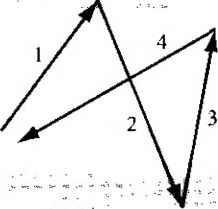 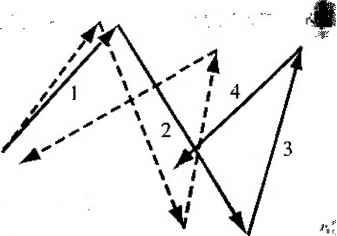 E field Figure S.l \ Typical random behavior of a hole in a semiconductor (a) without an electric field and (b) with an electric field. applied as indicated in Figure 5.1b, there will be a net drift of the hole in the direction of the E-field, and the net drift velocity will be a small perturbation on the random i thermal velocity, so the time between collisions will not be altered appreciably. If we; use the mean time between collisions т,.р in place of the time t in Equation (5.11), then the mean peak velocity just prior to a collision or scattering event is trfjpeak (5.12a) The average drift velocity is one half the peak value so that we can write (Vd) = 2 \ ml (5.12b) However, the collision process is not as simple as this model, but is statistical in nature. In a more accurate model including the effect of a statistical distribution, the factor in Equation (5.12b) does not appear. The hole mobility is then given by (5.13) The same analysis applies to electrons; thus we can wTite the electron mobility as (5.14) where г^. is the mean time between collisions for an electron. There are two collision or scattering mechanisms that dominate in a semiconductor and affect the carrier mobility: phonon or lattice scattering, and ionized impurity scattering. The atoms in a semiconductor crystal have a certain amount of thermal energy at temperatures above absolute zero that causes the atoms to randomly vibrate about their lattice position within the crystal. The lattice vibrations cause a disruption in ih 1 ... 13 14 15 16 17 18 19 ... 55 |
|
© 2026 AutoElektrix.ru
Частичное копирование материалов разрешено при условии активной ссылки |