 |
 |
 |
| Главная Журналы Популярное Audi - почему их так назвали? Как появилась марка Bmw? Откуда появился Lexus? Достижения и устремления Mercedes-Benz Первые модели Chevrolet Электромобиль Nissan Leaf |
Главная » Журналы » Absorbing materialorganic polymer 1 ... 42 43 44 45 46 47 48 ... 55 CHAPTER 10 TheBipolar Transistor actual distribuuon given by Equation (IОТ5a), determine at X = Хв/2 for (a) xb/Lb =0.1 and {b) Xb/Lb = 1-0. Assume Vbe > кТ/е. 10.15 Consider a pnp bipolar transistor. Assume that the excess minority carrier hole concentrations at the edges of the B-E and B-C space charge regions are 8рв(0) = 8 x 10 * cm and 8рв(хв) - -2.25 x 10 cm-\ respectively. Plot, on the same graph, SpBix) for (a) the ideal case when no recombination occurs in the base, and (b) the case when Хв = L/j = 10 pm. (r) Assuming Db = 10 cm/s, calculate the diffusion current density at л =0 and л = л д for the conditions in parts (a) and (b). Determine the ratio J(x xb)/J{x = 0) for the two cases. * 10.16 (a) A uniformly doped npn bipolar transistor at Г = 300 К is biased in saturation. Starting with the continuity equation for minority carriers, show that the excess electron concentration in the base region can be expressed as 8пв(х) = n л for Xb/Lb < 1 where Хв is the neutral base width, (b) Show that the minority carrier diffusion current in the base is then given by Л = - eDBtieo (c) Show that the total excess minority carrier charge (C/cm-) in the base region is given by 8QnB = -епвохв 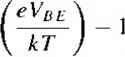 * 10.17 Consider a silicon pnp bipolar transistor al T = 300 К with uniform dopings of = 5 x 10 cm- Nb = 10 cm- and Nc = 5x 10 cm- Let Db = 10 cm-/s, Xb = 0.7 pm, and assume хв < Lb. The transistor is operating in saturation with 7, = 165 A/cm and Veb 0.75 V. Determine (a) Vcb (b) V/rc(sat), {c} the #/cnr of excess minority carrier holes in the base, and (d) the #/cm of excess minority carrier electrons in the long collector. Let Lc = 35 pm. 10.18 An npn silicon bipolar transistor at T = 300 К has uniform dopings of Ne = 10 cm , Nb = 10 cm , and Nc =1 x 10 cmV The transistor is operating in the inverse-active mode with Vbe = -2 V and Vbc = 0.565 V. {a) Sketch the minority carrier distribution through the device, (h) Determine the minority carrier concentrations at л' = л^ and x -0. (r) If the metallurgical base width is 1.2 pm, determine the neutral base width. 10Л9 A uniformly doped silicon pnp bipolar transistor at Г = 300 К with dopings of Л^/г = 5 x 10 cm--\ Nb = 10 cm , and Nc = 5 x 10 cm is biased in the inverse-active mode. What is the maximum B-C voltage so that the low-injection condition applies? Problems 441 Section 103 Low-Frequency Common-Base Current Gain 10.20 The following currents are measured in и uniformly doped npn bipolar transistor: / t = 1.20 mA IpE = 0Л0 mA / c = 1.18 mA 0.20 mA fa = 0.00 i mA fp.o - 0.001 mA Ffetermine (a) a, (b) y, (c)ar, (d)S, and (e) 10.21 A silicon npn transistor at Г = 300 К has an area of 10 - cm-, neutral base width of 1 jLim, and doping concentrations of - cm~-, Nb = cm\ = 10 с m~-. Other sem iconductor parameters are Db = 20cm/s, т^с ro = 10~ s, and гсо = 10 s. Assuming the transistor is biased in the active region and the recombination factor is unity, calculate the collector current for: (a) Vbe 0.5 V, {b) it: = 1.5 niA, and (c) = 2 дA. 10.22 Consider a uniformly doped npn bipolar transistor at Г = 300 К with the following parameters: Ne -- 10** cm УVj = 5 x lO cm Nc = 10 cm De cm/s Db = \5 cm/s Dc = 12 cmVs = 10- s Tbo = 5x10⁻⁴ Гсо - Ю s JC£ =0.8 iim Xb - 0.7 дт Лп =3x10 A/cm For Vbl = 0.60 V and Vce = 5 V, calculate (a) the cuiTents 7 £-, 7,£, 7 and Jr and (I?) the current gain factors )/, a/, , and /if. 10.23 Three npn bipolar transistors have identical parameters except for the base doping concentrations and neutral base widths. The base parameters for the three devices are as follows:
(The base doping concentration for the В device is twice that of A and C, and the neutral base width for the С device is half that of A and BO {a) Determine the ratio of the emitter injection efficiency of (0 device В to device A and (ii) device С to device A. {h) Repeat part (a) for the base transport factor, (c) Repeat part (a) for the recombination factor (J) Which device has the largest common-emitter current gain /?? 10.24 Repeat Problem 10.23 for three devices in which the emitter parameters vary. The emitter parameters for the three devices are as follows:
10.25 An npn silicon transistor is biased in the inverse active mode with Vst: = -3 V andj Т/д^- = 0.6 V, The doping concentrations are Л^ = 10 cm~\ TV 10 cm~, Nc =10 cm \ Other parameters агелд - I дт, т^о = = тсо - 2 x 10 Di = 10 cnr/s. Db = 20 cmVs, =15 cmVs, and Л = 10 cm. ( ) Calculat and plot the minonty carrier distribution in the device, (b) Calculate the collector and emitter cunents. (Neglect geometry factors and assume the recombination factor is unity.) 10-26 (a) Calculate the base transport factor, ат, for Xb/Lb = 0.01.0.10, 1.0, and 10. Assuming that у and В are unity, determine P for each case, {b) Calculate the emitter injection efficiency, for Nb/Ne = 0.01, 0.10, 1.0, and 10, Assuming that ctj and S are unity, determine for each case, (c) Considering the results of parts {a) and {Ь\ what conclusions can be nnadc concerning when the base transport factor or when the emitter injection efficiency are the limiting factors for the common-emitter current gain? 10.27 (a) Calculate the recombination factor for Vbk = 0.2,0.4, and 0.6 V, Assume the following parameters:
(6) Assuming the base transport and emitter injection efficiency factors are unity, calculate the common-emitter current gain for the conditions in part (a), (c) Considering the results of part (h), what can be said about the recombination factor being the limiting factor in the common emitter current gain. 10.28 Consider an npn silicon bipolar transistor at Г 300 К with the following parameters: Db = 25 cmVs D = 10 cm/s ro = 10 s = 5 X 10 S Nb = 10 cm- Xe - 0.5 pm The recombinafion factor, has been determined to be 5 = 0.998. We need a common-emitter current gain of = 120. Assuming that ar y, determine the maximum base width, .vjg, and the minimum emitter doping, Ne, to achieve this specification. *10.29 {a) The recombination current density, Ло, in an npn silicon bipolar transistor at T = 300 к is Ло = 5x 10- A/cm-. The uniform dopings are Ne = 10 cш Nb = 5 X \0 cm~\ and Nc = 10* cm~. Other parameters are - 10 cm/s, Db =25 cm/s, r = 10~ s, and тво = 10 s. Determine the neutral base width so that the recombination factor is 5 = 0.995 when Vbe = 0.55 V (/>) If Ло remains constant with temperature, what is the value of 5 when Vbe = 0.55 V for the case when the temperature is Г = 400 К? Use the value ofxB determined in part (a). 10.30 (a) Plot, for a bipolar transistor, the base transport factor, ar. as a function of {xb/Lb) over the range 0.01 < {xe/Lb) 5 10. (Use a log scale on the horizontal axis.) Problems 443 (/;) Assuming that the emitter injection efficiency and recombination factors are unity, plot the common emitter gain for the conditions in part (a), (c) Considering the results of part (b), what can be said about the base transport factor being the limifing factor in the common emitter current gain? 10.31 (a) Plot the emitter injection efficiency as a funcfion of the doping rafio, Nb /Ne ,over the range 0.01 < Nb/Ne < 10. Assume that De = Db. Lb = Le. andj: - л/г. (Use a log scale on the horizontal axis.) Neglect bandgap narrowing effects, (b) Assuming that the base transport factor and recombinadon factors are unity, plot the common einitter current gain for the conditions in part (a), (c) Considering the results of part (b), what can be said about the emitter injecUon efficiency being the limiting factor in the common emitter current gain. (a) Plot the recombination factor as a function of the forward-bias B-E voltage for 0.1 < Vbe S 0.6. Assume the following parameters: Db = 25 cm/s De - 10 cmVs Ne = 5x 10 cm- Л^д = 1 x 10 cm Л^с = 5 x lO cm Xb = 0.7 дш TBi) = гео 10 s 7,-0 = 2 x 10- A/cm n, = 1.5 x 10 cm- {h) Assuming the base transport and emitter injection efficiency factors are unity, plot the common emitter current gain for the conditions in part (a), (c) Considering the results of part (/?), what can be said about the recoinbination factor being the limiting factor in the common emitter current gain. 10.33 The emitter in a BJT is often made very thin to achieve high operating speed. In this problem, we investigate the effect of emitter width on current gain. Consider the emitter injection efficiency given by Equation (10.35a). Assume that N = IOONb. De = Db, and = Lb - Also let xg =0.1Lb. Plot the emitter injection efficiency for 0.OIL i < Xe < lOLf. From these results, discuss the effect of emitter width on the current gain. Section 10.4 Nonideal Effects 10.34 A silicon pnp bipolar transistor at Г = 300 К has uniform dopings of Ne = 10* cm~, Nb = 10 cm~, and Nc = 10 cm . The metallurgical base width is 1.2 /tm. Let = 10 cm/s and Гдо = 5 x 10~ s. Assume that the minority carrier hole concentration in the base can be approximated by a linear distribution. Let Veh = 0.625 V, (a) Detennine the hole diffusion current density in the base for V = 5 V, Vfic = 10 V, and Vbc = 15 V. (b) Estimate the Eariy voltage. * 10.35 The base width of a bipolar transistor is normally small to provide a large current gain and increased speed. The base width also affects the Early voltage. In a silicon npn bipolar transistor at T = 300 K, the doping concentrations are Ne = 10 cm *, Nb = 3 x 10 cm--\ and /Vr = 5 x 10 cm- Assume Db = 20 cmVs and Tbo = 5 x 10- s, and let Vbe = 0.70 V. Using voltages Vcs = 5 V and Vcb = 10 V as two data points, esfimate the Early voltage for metallurgical base widths of (a) 1.0 дт, (b) 0.80 дm, and (c) 0.60 дт.    10.36 An npn siHcon bipolar transistor has a base doping concentration of Ng - 10 cm 1037  10.38 10,39 10.40 a collector doping concentration of Nc = 10 cm~, a metallurgical base width of IT дт, and a base minority carrier diffusion coefficient of Db = 20 cm/s. The transistor is biased in the forward-active region with Vbe = 0.60 V. Determine (a) the change in the neutral base width as Vcb changes from 1 V to 5 V, and {b) the corresponding change in the collector current. Consider a uniformly doped silicon npn bipolar transistor in which Xe xb Le = lb,£ind De = Db- Assume that ат = В = 0.995 and let Л^ = 10 cm~ Calculate and plot the common emitter current gain for Ne = 10, 10 10, and 10 cm and for the case (a) when the bandgap narrowing effect is neglected, and (b) when the bandgap narrowing effect is taken into account. A silicon pnp bipolar transistor at 7 = 300 К is to be designed so that the emitter injection efficiency isy = 0.996. Assume that/r = хв, Le - Lb, De - Db, and let Ne = \0 cm~. (a) Determine the maximum base doping, taking into accouni bandgap narrowing, {b) If bandgap narrowing were neglected, what would be the maximum base doping required? A first-approximafion type calculation of the current crowding effect can be made using the geometry shown in Figure 10.51. Assume that one-half of the base current enters from each side of the emitter strip and flows uniformly to the center of the emitter Assume the base is p type with the following parameters: в 10 cm- /x = 400 cmVV-s Emitter length Xb - 0.70 дт 5 = 8 дт L 100 дт {a) Calculate the resistance between x = 0 and x = S/2. (b) If j I в - 10 д A, calculate the voltage drop between jc = 0 and x = S/2. (c) If Vst = 0.6 V at jt = 0 estimate in percent the number of electrons being injected into the base at x = S/2 compared to x =0. Consider the geometry shown in Figure 10.51 and the device parameters in Problem 10-39 except the emitter width S. The emitter width S is to be changed so that the number of electrons injected into the base at л 5/2 is no more than 10 percent less than the number of electrons injected into the base at jc = 0. Calculate
A = 0 Xb x = S/2 Figure 10.51 I Figure for Problems 10.39 and 10.40. Probtems *10.41 The base doping in a diffused n pn bipolar transistor can be approximated by an exponential as Nb Nb (0) exp where д is a constant and is given by б(О) \ {хвУ) {a) Show that, in thermal equilibrium, the electric field in the neutral base region is a constant, {b) Indicate the direcUon of the electric field. Does this electric field aid or retard the flow of minority carrier electrons across the base? (c) Derive an expression for the steady-state minority canrier electron concentration in the base under forward bias. Assume no recombination occurs in the base. (Express the electron concentrafion in terms of the electron current density.) 10.42 Consider a sihcon npn bipolar transistor with uniform dopings of jV =5 x UV cm *, /Vjg 10 cm~-, and iVf =5 x 10 cm-. Assume the common-base current gain is a -- 0.9920. Determine ia) В Vcbo , ib) Veto, and (c) the base-emitter breakdown voltage. (Assume 3 for the empirical constant.) 10.43 A high-voltage silicon npn bipolar transistor is to be designed such that the uniform base doping h Nb = 10 cm~- and the common-emitter current grain is =50. The breakdown voltage BVcfo is to be at least 60 V. Determine the maximum collector doping and the minimum collector length to support this voltage. (Assume n -- 3.J 10.44 A uniformly doped silicon epitaxial npn bipolar transistor is fabricated with a base doping oi Nb =3 x 10 cm * and a heavily doped collector region with Nc = 5 X cm -\ The neutral base width is = 0.70 дт when Vbe = вс = 0. Determine Vc a I which punch-through occurs. Compiire this value to the expected avalanche breakdown voltage of the junction. 10.45 A silicon npn bipolar transistor has a base doping concentration oi Nb = 10* cm, a collector doping concentration of = > lO** cm , and a inetallurgical base width of 0.50 дт. Let Vgr 0.60 V. (a) Determine Vce at punch-through. ih) Determine the peak electric field in the B-C space charge region at punch-through. 10.46 A uniformly doped silicon pnp bipolar transistor is to be designed with Ne = 10* cm and Nc = 10* cm~-\ The metallurgical base width is 0.75 дт. Determine the minimum base doping so that the punch-through voltage is no less than Vpt - 25 V. Section lO.S Equivalent Circuit Models 10.47 The Vc/:(sat) voltage of an npn transistor in saturafion confinues to decrease slowly as the base current increases. In the Ebers-Moll model, assume aE = 0.99, of 0.20, and I с = 1 mA. For T = 3(Ю К, determine the base current, I в > necessary to give ia) Vc£(sat) 0.30 V, ib) Vc£(sat) = 0.20 V, and (c) Vc£(sat) = 0.10 V. 10.48 Consider an npn bipolar transistor biased in the active mode. LJsing the Ebers-Moll mtxlel, derive the equation for the base cuirent, , in terms of otf , , /5, /c5, and      10.49 Consider the Ebers-Moll model and let the base terminal be open so /д =0. SI that, when a collector-emitter voltage is applied, we have h- - Jcto = h sTT----~- (1 -af) 10.50 In the Ebers-Moll model, let - 0.98, = Ю A, and As 5 x 10 Aai 7 = 300 K. Ph)t fc versus for -У^ < Vch < 3 V and for V£ = 0.2,0.4. and 0.6 V. (Note that Vcn = -Уцс-) What can be said about the base width modulation effect using this model? 10.51 The collector-emitter saturation voltage, from ihe Ebers-Moll model, is given by Equation (10.77). Consider a power BJT in which - 0.98, a - 0.20, and I с --I A. Plot Vet (sat) versus over the range 0.03 < in < l.O A. Section 10,6 Frequency Limitations 10.52 Consider a silicon npn transistor at I - 300 K. Assume the following parameters: It = 0.5 mA C), -- 0.8 pF Xs = 0.7 fim D -- 25 cm/s XtH: =2.0 fim r, = 30 C, = C = 0.0 pF p = 50 {a) Calculate the transit time factors, ф) Calculate the cutoff and beta cutoff frequencies, and /f. respectively. 10.53 In a particular bipolar transistor, the base transit time is 20 percent of the total delay time. The base width is 0.5 дт and the base diffusion coefficient is />д =20 cm/s. Determine the cutoff frequency. 10.54 Assume the base transit time of a BJT is 100 ps and carriers cross the 1.2 um B-C space charge region at a speed of 10 cm/s. The emitter-base junction charging time is 25 ps and the collector capacitance and resistance arc 0.10 pF and 10 . respectively. Determnie the cutoff frequency. Summary and Review * 10.55 (a) A silicon npn bipolar transistor at T = 3(X) К is to be designed with an Early voltage of at least 200 V and a current gain of at least fi = 80. (b) Repeat part (a) for] a pnp bipolar transistor * 10.56 Design a uniformly doped silicon npn bipolar transistor so that fi = 100 at T = 300 K. The maximum CE voltage is lo be 15 V and any breakdown voltage is to be at least 3 times this value. Assume the recombination factor is constant at 5 = 0.995. The transistor is to be operated in low injection with a maximum collector current of Ic - 5 mA. Bandgap narrowing effects and base width modulation effects are to be minimized. Let Dy = 6 cm-/s, Dg ~ 25 cnr/s, т^о =10 s. and Гш) = 10 s. Determine doping concentrations, the metallurgical base width, the active area, and the maximum allowable Vbe- *10.57 Design a pair of complementary npv and pnp bipolar transistors. The transistors are to have the same metallurgical base and emiiter widths of Wg 0.75 дт and , Reading List 447 Xe =0.5 /tm. Assume that the foUowing minority carrier parameters apply to each device. D 23 cmVs T,;o = 10 4 Df, 8 cnr/s 5 X 10 * s The collector doping concentration in each device is 5 x 10 cm * and the recombination factor in each device is constant at 5 = 0.9950. (a) Design, if possible, the devices so that - 100 in each device. If this is not possible, how close a match can be obtained? (b) With equal forward-bias base-emitter voltages applied, the collector currents are to be /t- =5 mA with each device operating in low-injection. Determine the active cross-sectional areas. READING LIST L Dimitrijev, S. Understanding Semiconductor Devices, New York: Oxford University Press, 2000. 2. Kano, K. Semiconductor Devices. Upper Saddle River, NJ: Prentice Hall, 1998. 3. Muller, R. S., and T. I. Kamins. Device Electronics for Integrated Circuits. 2nd ed. New York: Wiley, 1986. 4. Navon, D. H. Semiconductor Microdevices and Materials. New York: Holt, Rinehart, & Winston, 1986. 5. Neudeck, G. W. The Bipolar Junction Transistor Vol. 3 of the Modular Series on SvUd State Devices. 2nd ed, Reading, MA: Addison-Wesley, 1989. 6. Ng, K, K, Complete Guide to Semiconductor Devices. New York: McGraw-Hill, 1995. 7. Ning, T H., and R. D. Isaac. Effect of Emitter Contact on Current Gain of Silicon Bipolar Devices. Polysilicon Emitter Bipolar Transistors, eds. A. K. Kapoor and D. J. Roulston. New York: IEEE Press, 1989. 8. Pierret, R. ¥, Semiconductor Device Eundamentals. Reading, MA: Addison-Wesley, 1996. 9. Roulston, D. J. Bipolar Semiconductor Devices. New York: McGraw-Hill, 1990. 10. Roulston, D. J. An Introduction to the Physics of Semiconductor Devices, New York: Oxford University Press, 1999. *11. Shur, M. GaAs Devices and Circuits. New York; Plenum Press, 1987. 12. Shur, M. Introduction to Electronic Devices. New York: John Wiley Sc Sons, Inc., 1996. *I3. Shur, M. Physics of Semiconductor Devices. Englewood ClifTs, NJ: Prentice Hall, 1990. 14. Singh, J. Semiconductor Devices: An Introduction. New York: McGraw-Hili, 1994. 15. Singh, J. Semiconductor Devices: Basic Principles, New York: John Wiley & Sons, Inc., 2001. 16. Streetman, B. G., and S. Banerjee. Solid State Electronic Devices, 5th ed. Upper Saddle River, NJ: Prentice Hall, 2000, 17- Sze, S. M, High-Speed Semiconductor Devices, New York: Wiley, 1990. 18- Sze, S, M, Physics of Semiconductor Devices. 2nd ed. New York: Wiley, 198L 19. Tiwari, S S. L, Wright, and A. W. Kleinsassen Transport and Related Properties of (Ga, Al)As/GaAs Double Heterojunction Bipolar Junction Transistors. IEEE Transactions on Electron Devices, ED-34 (February 1987), pp. 185-87. *20. Taur, Y., and T. H, Ning. Fundamentals oj Modern VLSI Devices. New York: Cambridge University Press, 1998. *21. Wang, S. Fundamentals of Semiconductor Theory and Device Physics. Englewood Cliffs, NJ: Prentice Hall, 1989. *22. Warner, R. M Jr., and B, L. Grung. Transistors: Fundamentals for the Integrated-Circuit Engineer. New York: Wiley, 1983. 23. Yang, E. S. Microelectronic Devices. New York: McGraw-Hill, 1988. *24. Yuan, J. S. SiGe. GaAs, and InP Heterojunction Bipolar Transistors. New York: John Wiley Sc Sons, Inc., 1999.  Fundamentals of the Metal-Oxide-Semiconductor Field-Effect Transistor PREVIEW The fundamental physics of the Metal-Oxide-Semiconductor Field-Effect Transistor (MOSFET) is developed in this chapter. Although the bipolar transistor was discussed in the last chapter, the inaterial in this chapter presumes a knowledge only of the semiconductor material pn>perlies and characteristics of the pn junction. The MOSFET, in conjunction with other circuit elements, is capable of voltage gain and signal-power gain. The MOSFET is also used extensively in digital circuit applications where, because of its relatively small size, thousands of devices can be fabricated in a single integrated circuit. The MOSFET is, without doubt, the core of integrated circuit design at the present time. The MOS designation is implicity used only for the metal-silicon dioxide (SiO)-silicon system. The more general terminology is metal-insulator-semiconductor (MIS), where the insulator is not necessarily silicon dioxide and the semiconductor is not necessarily silicon. We will use the MOS system throughout this chapter although the same basic physics applies to the MIS system. The heart of the MOSFET is a metal-oxide-semiconductor structure known as an MOS capacitor. The energy bands in the semiconductor near the oxide-semiconductor interface bend as a voltage is applied across the MOS capacitor. The position of the conduction and valence bands relative to the Fermi level at the oxide-semiconductor interface is a function of the MOS capacitor voltage, so that the characteristics of the semiconductor surface can be inverted from p-type to n-type, or from n-type to p-type, by applying the proper voltage. The operation and characteristics of the MOSFET are dependent on this inversion and the creation of 1 ... 42 43 44 45 46 47 48 ... 55 |
||||||||||||||||||||||||||||||||||||||||||||||||||||||||||||||||
|
© 2026 AutoElektrix.ru
Частичное копирование материалов разрешено при условии активной ссылки |