 |
 |
 |
| Главная Журналы Популярное Audi - почему их так назвали? Как появилась марка Bmw? Откуда появился Lexus? Достижения и устремления Mercedes-Benz Первые модели Chevrolet Электромобиль Nissan Leaf |
Главная » Журналы » Simple coaxial reflectometer 1 ... 72 73 74 75 76 77 78 ... 80 NOISE CENERAfOR 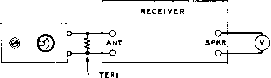 dlNATING resistor TEST SET-UP FOR NOISE GENERATOR Figure 27 resistor may be mounted permanently inside of the case. Using the The test setup for use of Noise Generator the noise generator is shown in figure 27. The noise gen- erator is connected to the antenna terminals of the receiver under test. The receiver is turned on, the a.v.c. turned off, and the r-f gain control placed full on. The audio volume control is adjusted until the output meter advances to one-quarter scale. This reading is the basic receiver noise. The noise generator is turned on, and the noise level potentiometer adjusted until the noise output voltage of the receiver is doubled. The more resistance in the diode circuit, the better is the signal-to-noise ratio of the receiver under test. The r-f circuits of the receiver may be aligned for maximum signal-to-noise ratio with the noise generator by aligning for a 2/1 noise ratio at minimum diode current. CHAPTER THIRTY-FIVE Radio Mathematics and Calc Radiomen often fiavc occasion to calculate sizes and values of required parts. This requires some knowledge of mathematics. The following pages contain a review of those parts of mathematics necessary to understand and apply the information contained in this book. It is assumed that the reader has had some mathematical training; this chapter is not intended to teach those who have never learned anything of the subject. Fortunately only a knowledge of fundamentals is necessary, although this knowledge must include several branches of the subject. Fortunately, too, the majority of practical applications in radio work reduce to tbe solution of equations or formulas or the interpretation of graphs. Arithmetic Notation of Numbers In writing numbers in the Arabic system we employ ten different symbols, digits, or figures: 1, 2, 3, 4, 5, 6, 7, 8, 9, and 0, and place them in a definite sequence. If there is more than one figure in the number the position of each figure or digit is as important in determining its value as is the digit itself. When we deal with whole numbers the righthandmost digit represents units, the next to the left represents tens, the next hundreds, the next thousands, from which we derive the rule that every time a digit is placed one space further to the left its value is multiplied by ten. 8 14 3 thousands hundreds units It will be seen that any number is actually a sum. In the example given above it is the sum of eight thousands, plus one hundred, plus four tens, plus three units, which could be written as follows: thousands hundreds tens units 10x10x10) 10x10) 8143 The number in the units position is sometimes referred to as a first order number, that in the tens position is of the second order, that in the hundreds position the third order, etc. The idea of letting the position of the symbol denote its value is an outcome of the abacus. The abacus had only a limited number of wires with beads, but it soon became apparent that the quantity of symbols might be continued indefinitely towards the left, each further space multiplying the digits value by ten. Thus any quantity, however large, may readily be indicated. It has become customary for ease of reading to divide large numbers into groups of three digits, separating them by commas. 6,000,000 rather than 6000000 Our system of notation then is characterized by two things: the use of positions to indicate the value of each symbol, and the use of ten symbols, from which we derive the name decimal system. Retaining the same use of positions, we might have used a different number of symbols, and displacing a symbol one place to the left might multiply its value by any other factor such as 2, 6 or 12. Such other systems have been in use in history, but will not be discussed here. There are also systems in which displacing a symbol to the left multiphes its value by 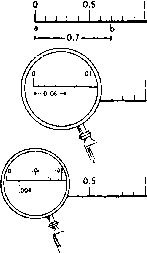 Figure 1. AN ILLUSTRATION OF LINEAR FRACTIONS. varying factors in accordance witli complicated rules. The English system of measurements is such an inconsistent and inferior system. Decimal Fractions Since we can extend a number indefinitely to the left to make it bigger, it is a logical step to extend it towards the right to make it smaller. Numbers smaller than unity are fractions and if a displacement one position to the right divides its value by ten, then the number is referred to as a decimal fraction. Thus a digit to the right of the units column indicates the number of tenths, the second digit to the right represents the number of hundredths, the third, the number of thousandths, etc. Some distinguishing mark must be used to divide unit from tenths so that one may properly evaluate each symbol. This mark is the decimal point. A decimal fraction like jour-tenths may be written .4 or 0.4 as desired, the latter probably being the clearer. Every time a digit is placed one space further to the right it represents a ten times smaller part. This is illustrated in Figure 1, where each large division represents a unit; each unit may be divided into ten parts although in the drawing we have only so divided the first part. The length ab is equal to seven of these tenth parts and is written as 0.7. The next smaller divisions, which should be written in the second column to the right of the decimal point, are each one-tenth of the small division, or one one-hundredth each. They are so small that we can only show them by imagining a magnifying glass to look at them, as in Figure 1. Six of these divisions is to be written as 0.06 (six hundredths). We need a microscope to see the next smaller division, that is those in the third place, which will be a tenth of one one-hundredth, or a thousandth; four such divisions would be written as 0.004 (four thousandths). H E Figure 2. IN THIS ILLUSTRATION FRACTIONAL PORTIONS ARE REPRESENTED IN THE FORM OF RECTANGLES RATHER THAN LINEARLY. ASCD = I.O;GF£D = 0.1; KJCH = 0.0 Г; each imall section wititin KJEH equoit 0.00 Г It should not be thought that such numbers are merely of academic interest for very small quantities are common in radio work. Possibly the conception of fractions may be clearer to some students by representing it in the form of rectangles rather than linearly (see Figure 2). Addition When two or more numbers are to be added we sometimes write them horizontally with the plus sign between them. + is the sign or operator indicating addition. Thus if 7 and 12 are to be added together we may write 7 + 12 = 19. But if laiger or more numbers are to be added together they are almost invariably written one under another in such a position that the decimal points fall in a vertical line. If a number has no decimal point, it is still considered as being just to the right of the units figure; such a number is a whole number or integer. Examples: 654 32 53041 53727 0.654 3.2 53.041 56.895 654 32 5304.1 5990.1 The result obtained by adding numbers is called the sum. Subtraction Subtraction is the reverse of addition. Its operator is - (the minus sign). The number to be subtracted is called the minuend, the number from which it is subtracted is the subtrahend, and the result is called the remainder. subtrohend - minuend remainder Examples: 65.4 -32 33.4 65.4 -32.21 33.19 Multiplication When numbers are to be multiplied together we use the X , which is known as the multiplication or the times sign. The number to be multiplied is known as the multiplicand and that by which it is to be multiplied is the multiplier, which may be written in words as follows: multiplicand X multiplier partial product partial product product The result of the operation is called the product. From the examples to follow it will be obvious that there are as many partial products as there are digits in the multiplier. In the following examples note that the righthandmost digit of each partial product is placed one space farther to the left than the previous one. 834 X 26 5004 1668 21684 834 X 206 5004 ООО 1668 171804 In the second example above it will be seen that the inclusion of the second partial product was unnecessary; whenever the multiplier contains a cipher (zero) the next partial product should be moved an additional space to the left. Numbers containing decimal fractions may first be multiphed exactly as if the decimal point did not occur in the numbers at all; the position of the decimal point in the product is determined after all operations have been completed. It must be so positioned in the product that the number of digits to its right is equal to the number of decimal places in the multiplicand plus the number of decimal places in the multiplier. This rule should be well understood since many radio calculations contain quantities which involve very small decimal fractions. In the examples which follow the explanatory notations 2 places, etc., are not actually written down since it is comparatively easy to determine the decimal points proper location mentally. 5.43 X0.72 1086 3 801 2 places 2 places 3.9096 2-1-2 = 4 places 0.04 2 places X 0.003 3 places 0.00012 2-f 3 = 5 places Division Division is the reverse of multiplication. Its operator is the which is called the division sign. It is also common to indicate division by the use of the fraction bar (/) or by writing one number over the other. The number which is to be divided is called the dividend and is written before the division sign or fraction bar or over the horizontal hne indicating a fraction. The num- ber by which the dividend is to be divided is called the divisor and follows the division sign or fraction bar or comes under the horizontal line of the fraction. The answer or result is called the quotient. quotient divisor ) dividend dividend divisor = quotient dividend divisor Examples: 834 ) 105084 834 - quotient 49) 2436 196 2168 1668 5004 5004 476 441 35 remainder Another example: Divide 0.000325 by 0.017. Here we must move the decimal point three places to the right in both dividend and divisor. 0.019 17) 0.325 17 155 153 In a case where the dividend has fewer decimals than the divisor the same rules still may be applied by adding ciphers. For example to divide 0.49 by 0.006 we must move the decimal point three places to the right. The 0.49 now becomes 490 and we write: 6 ) 490 48 10 б Note that one number often fails to divide into another evenly. Hence there is often a quantity left over called the remainder. The rules for placing the decimal point are the reverse of those for multiplication. The number of decimal places in the quotient is equal to the difference between the number of decimal places In the dividend and that in the divisor. It is often simpler and clearer to remove the decimal point entirely from the divisor by multiplying both dividend and divisor by the necessary factor; that is we move the decimal point In the divisor as many places to the right as is necessary to make it a whole number and then we move the decimal point in the dividend exactly the same number of places to the right regardless of whether this makes the dividend a whole number or not. When this has been done the decimal point In the quotient will automatically come directly above that in the dividend as shown in the following example. Example: Divide 10.5084 by 8.34. Move the decimal point of both dividend and divisor two places to the right. 1.26 834) 1050.84 834 2168 1668 5004 5004 When the division shows a remainder it is sometimes necessary to continue the work so as to obtain more figures. In that case ciphers may be annexed to the dividend, brought down to the remainder, and the division continued as long as may be necessary; be sure to place a decimal point in the dividend before the ciphers are annexed if the dividend does not already contain a decimal point. For example: 80.33 б ) 482.00 20 18 20 18 This operation is not very often required in radio work since the accuracy of the measurements from which our problems start seldom justifies the use of more than three significant figures. This point will be covered further later in this chapter. Fractions Quantities of less than one (unity) are called fractions. They may be expressed by decimal notation as we ha,ve seen, or they may be expressed as vulgar fractions. Examples of vulgar fractions: numerator denominator The upper position of a vulgar fraction is called the numerator and the lower position the denominator. When the numerator is the smaller of the two, the fraction is called a proper fraction; the examples of vulgar fractions given above are proper vulgar fractions. When the numerator is the larger, the expression is an improper fraction, which can be reduced to an integer or whole number with a proper fraction, the whole being called a mixed number. In the following examples improper fractions have been reduced to their corresponding mixed numbers. 4 - 4 3 - 3 Adding or Subtrocting Fractions Except when the fractions are very simple it will usually be found much easier to add and subtract fractions in the form of decimals. This rule likewise applies for practically all other operations with fractions. However, it is occasionally necessary to perform various operations with vulgar fractions and the rules should be understood. When adding or subtracting such fractions the denominators must be made equal. This may be done by multiplying both numerator and denominator of the first fraction by the denominator of the other fraction, after which we multiply the numerator and denominator of the second fraction by the denominator of the first fraction. This sounds more complicated than it usually proves in practice, as the following examples will show. 1x3 1x2 2x3+3x2 6 + 6 4x5 5x4 15 20 5 б Except in problems involving large numbers the step shown in brackets above is usually done in the head and is not written down. Although in the examples shown above we have used proper fractions, it is obvious that the same procedure applies with improper fractions. In the case of problems involving mixed numbers it is necessary first to convert them into improper fractions. Example: , 3 2x7 -b 3 17 Z 7 - -y- The numerator of the improper fraction is equal to the whole number multiplied by the denominator of the original fraction, to which the numerator is added. That is in the above example we multiply 2 by 7 and then add 3 to obtain 17 for the numerator. The denominator is the same as is the denominator of the original fraction. In the following example we have added two mixed numbers. 7+*4 - 7 + 4 - 17x4 15 x 7 7x4 + 4x7 - 28 28 - 28 - 28 Multiplying All vulgar fractions are multi-Fractions plied by multiplying the numerators together and the denominators together, as shown in the following example: 4X5 - 3x2 4x5 As above, the step indicated in brackets is usually not written down since it may easily be performed mentally. As with addition and subtraction any mixed numbers should be first reduced to improper fractions as shown in the following example: X4, 2зХ 9 - ao - 13 23 Division of Fractions Example; Fractions may be most easily divided by inverting the divisor and then multiplying. J 2 v-l-- л - в Л Ч - In the above example it will be seen that to divide by is exactly the same thing as to multiply by 4/3. Actual division of fractions is a rather rare operation and if necessary is usually postponed until the final answer is secured when it is often desired to reduce the resulting vulgar fraction to a decimal fraction by division. It is more common and usually results in least overall work to reduce vulgar fractions to decimals at the beginning of a problem. Examples: - 0.375 = 0.15625 0.15625 32 ) 5.00000 11 1 80 1 60 200 192 80 64 160 160 It will be obvious that many vulgar fractions cannot be reduced to exact decimal equivalents. This fact need not worry us, however, since the degree of equivalence can always be as much as the data warrants. For instance, if we know that one-third of an ampere is flowing in a given circuit, this can be written as 0.33. amperes. This is not the exact equivalent of 1/3 but is close enough since it shows the value to the nearest thousandth of an ampere and it is probable that the meter from which we secured our original data was not accurate to the nearest thousandth of an ampere. Thus in converting vulgar fractions to a decimal we unhesitatingly stop when we have reached the number of significant figures warranted by our original data, which is very seldom more than three places (see section Significant Figures later in this chapter). When the denominator of a vulgar fraction contains only the factors 2 or 5, division can be brought to a finish and there will be no remainder, as shown in the examples above. When the denominator has other factors such as 3, 7, 11, etc., the division will seldom come out even no matter how long it is continued but, as previously stated, this is of no consequence in practical work since it may be carried to whatever degree of accuracy is necessary. The digits in the quotient will usually repeat either singly or in groups, although there may first occur one or more digits which do not repeat. Such fractions are known as repeating fractions. They are sometimes indicated by an obhque line (fraction bar) through the digit which repeats, or through the first and last digits of a repeating group. Example: = 0.3333 . . . , z=0. ~ - 0.142857142857 = 0.4285 The foregoing examples contained only repeating digits. In the following example a non-repeating digit precedes the repeating digit: = 0.2333 = 0.2 While repeating decimal fractions can be converted into their vulgar fraction equivalents, this is seldom necessary in practical work and the rules will be omitted here. Powers and When a number is to be mul-Roots tiplied by itself we say that it is to be squared or to be raised to the second power. When it is to be multipled by itself once again, we say that it is cubed or ra/,ed to the third power. In general terms, when a number is to be multipled by itself we speak of raising to a power or involution; the number of times which the number is to be multiplied by itself is called the order of the power. The standard notation requires that the order of the power be indicated by a small number written after the number and above the line, called the exponent. Examples: 2 X 2, or 2 squared, or the second power of 2 2 X 2 X 2, or 2 cubed, or tbe third power of 2 2 X 2 X 2 X 2, or the fourth power of 2 Sometimes it is necessary to perform the reverse of this operation, that is, it may be necessary, for instance, to find that number which multiplied by itself will give a product of nine. The answer is of course 3. This process is known as extracting the root or evolution. The particular example which is cited would be written: /9 = 3 The sign for extracting the root is which is known as the radical sign; the order of the root is indicated by a small number above the radical as in which would mean the fourth root; this number is called the index. When the radical bears no index, the square or second root is intended. Restricting our attention for the moment to square root, we know that 2 is the square root of 4, and 3 is the square root of 9. If we want the square root of a number between 3 and 9, such as the square root of 5, it is obvious that it must lie between 2 and 3. In general the square root of such a number cannot be exactly expressed either by a vulgar fraction or a decimal fraction. However, the square root can be carried out decimally as far as may be necessary for sufficient accuracy. In general such a decimal fraction will contain a never-ending series of digits without repeating groups. Such a number is an irrational number, such as = 2.2361 The extraction of roots is usually done by tables or logarithms the use of which will be described later. There are longhand methods of extracting various roots, but we shall give only that for extracting the square root since the others become so tedious as to make other methods almost invariably preferable. Even the longhand method for extracting the square root will usually be used only if loga- rithm tables, slide rule, or table of roots are not handy. Extracting the First divide the number the Square Root root of which is to be extracted into groups of two digits starting at the decimal point and going in both directions. If the lefthandmost group proves to have only one digit instead of two, no harm will be done. The righthandmost group may be made to have two digits by annexing a zero if necessary. For example, let it be required to find the square root of 5678.91. This is to be divided off as follows: V56 78.91 The mark used to divide the groups may be anything convenient, although the prime-sign () is most commonly used for the purpose. Next find the largest square which is contained in the first group, in this case 56. The largest square is obviously 49, the square of 7. Place the 7 above the first group of the number whose root is to be extracted, which is sometimes called the dividend from analogy to ordinary division. Place the square of this figure, that is 49, under the first group, 56, and subtract leaving a remainder of 7. /56 78.91 49 Bring down the next group and annex it to the remainder so that we have 778. Now to the left of this quantity write down twice the root so far found (2 X 7 or 14 in this example), annex a cipher as a trial divisor, and see how many times the result is contained in 778. In our example 140 will go into 778 5 times. Replace the cipher with a 5, and multiply the resulting 145 by 5 to give 725. Place the 5 directly above the second group in the dividend and then subtract the 725 from 778. 7 5 yj56 78.91 49 И5 X 5 7 78 7 25 53 The next step is an exact repetition of the previous step. Bring down the third group and annex it to the remainder of 53, giving 5391. Write down twice the root already found and annex the cipher (2 x 75 or 150 plus the cipher, which will give 1500), 1500 wiU go into 5391 3 times. Replace the last cipher with a three and multiply 1503 by 3 to give 4509. Place 3 above the third group. Subtract to find the remainder of 882. The quotient 75.3 which has been found so far is not the exact square root which was desired; in most cases it will be sufficiently accurate. However, if greater accuracy is desired groups of two ciphers can be brought down and the process carried on as long as necessary. 7 5. 3 /56 78.91 49 145 X 5 = 1500 1503 X 3 = 7 78 7 25 53 91 45 09 8 82 Each digit of the root should be placed directly above the group of the dividend from which it was derived; if this is done the decimal point of the root will come directly above the decimal point of the dividend. Sometimes the remainder after a square has been subtracted (such as the 1 in the following example) will not be sufficiently large to contain twice the root already found even after the next group of figures has been brought down. In this case we write a cipher above the group just brought down and bring down another group. 7. 0 8 2 /50.16 00 00 1400 1408 X 8 14160 14162 X 2 1 16 00 1 12 64 3 36 00 2 83 24 52 76 In the above example the amount II6 was not sufficient to contain twice the root already found with a cipher annexed to it; that is, it was not sufficient to contain 140. Therefore we write a zero above 16 and bring down the next group, which in this example is a pair of ciphers. Order ef One frequently encounters prob-Operations lems in which several of the fundamental operations of arithmetic which have been described are to be performed. The order in which these operations must be performed is important. First all powers and roots should be calculated; multiplication and division come next; adding and subtraction come last. In the example 2 -f 3 X 4 we must first square the 4 to get 16; then we multiply 16 by 3, making 48, and to the product we add 2, giving a result of 50. If a different order of operations were followed, a different result would be obtained. For instance, if we add 2 to 3 we would obtain 5, and then multiplying this by the square of 4 or 16, we would obtain a result of 80, which is incorrect. In more comphcated forms such as fractions whose numerators and denominators may both be in complicated forms, the numerator and denominator are first found separately before the division is made, such as In the following example: 3 X 4 -h S X 2 2x3-1-2-1-3 12 + 10 22 , 6-1-2-1-3- 11 - Problems of this type are very common in dealing with circuits containing several inductances, capacities, or resistances. The order of operations specified above does not always meet all possible conditions; if a series of operations should be performed in a different order, this is always indicated by parentheses or brackets, for example; 2-f3X4=:2--3Xl6=:2.f48 = 50 (2 -f 3) X 4= = 5 X 4 = 5 X 16 = 80 2 -f (3 X 4)= 2 + 12 = 2 -f 144 i= 146 In connection with the radical sign, brackets may be used or the hat of the radical may be extended over the entire quantity whose root is to be extracted. Example: V4.f5 = /4 + 5 = 2.f5 = 7 V (4 + 5) = \4 + 5 =/9 = 3 It is recommended that the radical always be extended over the quantity whose root is to be extracted to avoid any ambiguity. Cancellation In a fraction in which the numerator and denominator consist of several factors to be multiplied, considerable labor can often be saved if it is found that the same factor occurs in both numerator and denominator. These factors cancel each other and can be removed. Example:   ХЖХ In the foregoing example it is obvious that the 3 in the numerator goes into the 6 in the denominator twice. We may thus cross out the three and replace the 6 by a 2. The 2 which we have just placed in the denominator cancels the 2 in the numerator. Next the 5 in the denominator will go into the 25 in the numerator leaving a result of 5. Now we have left only a 5 in the numerator and a 7 in the denominator, so our final result is 5/7. If we had multipUed 2 X 3 X 25 to obtain 150 and then had divided this by 6 X 5 X 7 or 210, we would have obtained the same result but, with considerably more work. Algebra Algebra is not a separate branch of mathematics but is merely a form of generalized arithmetic in which letters of the alphabet and occasional other symbols are substituted for numbers, from which it is often referred to as literal notation. It is simply a shorthand method of writing operations which could be spelled out. The laws of most common electrical phenomena and circuits (including of course radio phenomena and circuits) lend themselves particularly well to representation by literal notation and solution by algebraic equations or formulas. While we may write a particular problem in Ohms Law as an ordinary division or multiplication, the general statement of all such problems calls for the replacement of the numbers by symbols. We might be explicit and write out the names of the units and use these names as symbols: volts = amperes X ohms Such a procedure becomes too clumsy when the expression is more involved and would be unusually cumbersome if any operations like multiplication were required. Therefore as a short way of writing these generalized relations the numbers are repiresented by letters. Ohms Law then becomes E = I X R In the statement of any particular problem the significance of the letters is usua ly indicated directly below the equation or formula using them unless there can be no ambiguity. Thus the above form of Ohms Law would be more completely written as: E = I X R where E = e.m.f. in voUs I = current in amperes R = resistance in ohms Letters therefore represent numbers, and for any letter we can read any number. When the same letter occurs again in the same expression we would mentally read the same number, and for another letter another number of any value. These letters are connected by the usual operational symbols of arithmetic, +, -, X, -н, and so forth. In algebra, the sign for division is seldom used, a division being usually written as a fraction. The multiplication sign, X, is usuaUy omitted or one may write a period only. Examples: 2 X a X Ь = 2ob 2.3.4.5a = 2X3X4X5Xo In practical applications of algebra, an expression usually states some physical law and each letter represents a variable quantity which is therefore called a variable. A fixed number in front of such a quantity (by which it is to be multiplied) is known as the coefficient. Sometimes the coefficient may be unknown, yet to be determined; it is then also written as a letter; k is most commonly used for this purpose. The Negative Sign In ordinary arithmetic we seldom work with negative numbers, although we may be short in a subtraction. In algebra, however, a number may be either negative or positive. Such a thing may seem academic but a negative quantity can have a real existence. We need only refer to a debt being considered a negative possession. In electrical work, however, a result of a problem might be a negative number of amperes or volts, indicating that the direction of the current is opposite to the direction chosen as positive. We shall have illustrations of this shortly. Having established the existence of negative quantities, we must now learn how to work with these negative quantities in addition, subtraction, multiphcation and so forth. In addition, a negative number Jdded to a positive number is the same as subtracting a positive number from it. - (add) - -1 (subtract) 4 4 or we might write it 7 + (-3) = 7- 3 = 4 Similarly, we have: a + (- b) = a - b When a minus sign is in front of an expression in brackets, this minus sign has the effect of reversing the signs of every term within the brackets: - a -f b - 2o - 3b -f 5c - (a - b) = (2o -H 3b - 5c) = Multiplication. When both the multiplicand and the multiplier are negative, the product is positive. When only one (either one) is negative the product is negative. The four possible cases are illustrated below: + X + = + - X + = - + X - = -- X - = -b Division. Since division is but the reverse of multiplication, similar rules apply for the sign of the quotient. When both the dividend and the divisor have the same sign (both negative or both positive) the quotient is positive. If they have unlike signs (one positive and one negative) the quotient is negative. + Ч- + ~ - ~ Powers. Even powers of negative numbers are positive and odd powers are negative. Powers of positive numbers are always positive. Examples: -2=-2X-2=+4 -r=-2X-2X-2=+4X - 2 = - 8 Roots. Since the square of a negative number is positive and the square of a positive number is also positive, it follows that a positive number has two square roots. The square root of 4 can be either +2 or -2 for ( + 2) X {+2) = +4 and (-2) X (-2) = +4. Addition and Polynomials are quantities Subtraction like 3ab + 4аЫ - 7ab which have several terms of different names. When adding polynomials, only terms of the same name can be taken together. 70= -t- 8 ob -t- 3 ob -f 3 a - 5 ob 8a -H 3 ob-J- 3 ob - b -f- 3 1 ... 72 73 74 75 76 77 78 ... 80 |
|
© 2026 AutoElektrix.ru
Частичное копирование материалов разрешено при условии активной ссылки |