 |
 |
 |
| Главная Журналы Популярное Audi - почему их так назвали? Как появилась марка Bmw? Откуда появился Lexus? Достижения и устремления Mercedes-Benz Первые модели Chevrolet Электромобиль Nissan Leaf |
Главная » Журналы » Simple coaxial reflectometer 1 ... 73 74 75 76 77 78 79 80 Collecting terms. When an expression contains more than one term of the same name, these can be added together and the expression made simpler: 5 + 2 xy + 3 xy - 3 x + 7 xy = 5 x - 3 x + 2 xy + 7 xy + 3 xy= 2 x= + 9 xy -f. 3 xy= Multiplicafion Multiphcation of single terms is indicated simply by writing them together. a X b is written as ab о X b is written as ob Bracketed quantities are multiplied by a single term by multiplying each term: a(b + с -f d) = ab -f ОС + ad When two bracketed quantities are multiplied, each term of the first bracketed quantity is to be multiplied by each term of the second bracketed quantity, thereby making every possible combination. (a + b) (c + d) = ac + ad + be + bd In this work particular care must be taken to get the signs correct. Examples: (a -H b) (o - b) = a= -H ab - ab - b = a - b= (o -H b) (o -f. b) = a= -f. ob -f. ab -H b= = a + 2ab -H b (o - b) < a - b) = a= - ab - ab + b = e= 2 ab -H b Division It is possible to do longhand division in algebra, although it is somewhat more complicated than in arithmetic. However, the division will seldom come out even, and is not often done in this form. The method is as follows: Write the terms of the dividend in the order of descending powers of one variable and do likewise with the divisor. Example: Divide 5ab + 21b -b 2a - 26ab by 2a - 3b Write the dividend in the order of descending powers of a and divide in the same way as in arithmetic. 2a - a -b 4 ab - 7b 3b ) 2a + 5a=b -- 26 ab + 21b 2a - 3ab + 8ab + Sab 26a b 12ab 14ab= -H 21b I4ab= + 21b Another example: Divide x - y by x - у X - у ) x -Ь О -f. О - у' ( + ху + у х^ - х-у + W - Г ху - у' Factoring Very often it is necessary to simplify expressions by finding a factor. This is done by collecting two or more terms having the same factor and bringing the factor outside the brackets: 6ab + 3ac = 3a (2b + c) In a four term expression one can take together two terms at a time; the intention is to try getting the terms within the brackets the same after the factor has been removed; ЗОае - ISbc -f lOad - 6bd = 6c (5a - 3b) 4- 2d (5a - 3b) = (5a - 3b) <6c -H 2d) Of course, this is not always possible and the expression may not have any factors. A similar process can of course be followed when the expression has six or eight or any even number of terms. A special case is a three-term polynomial, which can sometimes be factored by writing the middle term as the sum of two terms: x - 7xy -H I2y may be rewritten as x - 3xy 4xy -H 1 2y= - X (x - 3y) 4y (x - 3y) - (x - 4y) (x - 3y) The middle term should be split into two in such a way that the sum of the two new terms equals the original middle term and that their product equals the product of the two outer terms. In the above example these conditions are fulfilled for - 3xy - 4 xy = - 7xy and (-3xy) (- 4xy) - 12 ху. It is not always possible to do this and there are then no simple factors. Working with When two powers of the Powen same number are to be mul- and Roots tipUed, the exponents are added. a X 0 = oo X oca - ooaaa = a or a X a = a=* = о Ь= X b = У с X с = с Similarly, dividing of powers is done by subtracting the exponents. 0° - ооо - -----a or b bbbbb . J = bor °-=b - = b Now we are logically led into some important new ways of notation. We have seen that when dividing, the exponents are subtracted. This can be continued into negative exponents. In the following series, we successively divide by a and since this can now be done in two ways, the two ways of notation must have the same meaning and be identical. 0 = 1 a - a = J a These examples illustrate two rules: (1) any number raised to zero power equals one or unity; (2) any quantity raised to a negative power is the inverse or reciprocal of the same quantity raised to the same positive power. n = 1 a- = -It Roots. The product of the square root of two quantities equals the square root of their product. \Ло X /b = /оЬ Also, the quotient of two roots is equal to the root of the quotient. Note, however, that in addition or subtraction the square root of the sum or difference is not the same as the sum or difference of the square roots. Thus, vT- vT = 3-2=1 but /9 - 4 = /5 = 2.2361 Likewise + is not the some as Ve + Ь Roots may be written as fractional powers. Thus /! may be written as a because X /в = e ond, a X = o* = = 0 Any root may be written in this form /b = b л^=Ь^ л/Ь^=Ь'/* The same notation is also extended in the negative direction: e- = = Ь- - J --L Following the previous rules that exponents add when powers are multiplied, but also a X o = o therefore = \/~ Powers of powers. When a power is again raised to a power, the exponents are multiphed; <b-) = b- (b-)-= b This same rule also applies to roots of roots and also powers of roots and roots of powers because a root can always be written as a fractional power. VVr =for (flW-) = аУ Removing radicals. A root or radical in the denominator of a fraction makes the expression difficult to handle. If there must be a radical it should be located in the numerator rather than in the denominator. The removal of the radical from the denominator is done by multiplying both numerator and denominator by a quantity which will remove tbe radical from the denominator, thus rationalizing it: ! H j /o \/a X\/a ~ a Suppose we have to rationaiize 3a --j= In this case we must multiply numerator and denominator by - лГа, the same terms but with the second having the opposite sign, so that their product will not contain a root. 30 3o(\/a-\/bj 3g(Vo-vb) HANDBOOK Powers, Roots, Imaginaries 753 Imaginary Since the square of a negative Numbers number is positive and the square of a positive number is also positive, the square root of a negative number can be neither positive nor negative. Such a number is said to be imaginary; the most common such number (V-1) is often represented by the letter / in mathematical work or ; in electrical work. V - 1 = i or j and i° or j = - I Imaginary numbers do not exactly correspond to anything in our experience and it is best not to try to visualize them. Despite this fact, their interest is much more than academic, for they ate extremely useful in many calculations involving alternating currents. The square root of any other negative number may be reduced to a product of two roots, one positive and one negative. For instance: = /57 = i/57 or, in general V -a = i \/o Since i = V - 1, the powers of / have the following values: i = -1 1 = -1 X i = -i + \ i = + I X i = i Imaginary numbers arc different from either positive or negative numbers; so in addition or subtraction they must always be accounted for separately. Numbers which consist of both real and imaginary parts are called complex numbers. Examples of complex numbers: 3 -b 4i = 3 + 4 \ПГГ о -f bi = a -f b V -1 Since an imaginary number can never be equal to a real number, it follows that in an equality like a -f bi = с -f- di 0 must equal e and bi must equal di Complex numbers are handled in algebra just like any other expression, considering i as a known quantity. Whenever powers of i occur, they can be replaced by the equivalents given above. This idea of having In one equation two separate sets of quantities which must be accounted for separately, has found a symbolic apphcation in vector notation. These are covered later in this chapter. Equations of the First Degree Algebraic expressions usually come in the form of equations, that is, one set of terms equals another set of terms. The simplest example of this is Ohms Law: E = IR One of the three quantities may be unknown but if the other two are known, the third can be found readily by substituting the known values in the equation. This is very easy if it is E in the above example that is to be found; but suppose we wish to find / while E and R are given. We must then rearrange the equation so that / comes to stand alone to the left of the equality sign. This is known as solving the equation for I. Solution of the equation in this case is done simply by transposing. If two things are equal then they must still be equal if both are multi- >lied or divided by the same number. Dividing )Oth sides of the equation by R: If it were required to solve the equation for R, we should divide both sides of the equation by /. ~ = R or R = A little more complicated example is the equation for the reactance of a condenser: 2nf с To solve this equation for C, we may multi-sly both sides of the equation by С and divide )oth sides by X С 1 This equation is one of those which requires a good knowledge of the placing of the decimal point when solving. Therefore we give a few examples: What is the reactance of a 25 /t/tfd. capacitor at 1000 kc In filling in the given values in the equation we must remember that the units usee are farads, cycles, and ohms. Hence, we must write 25 fifiid. as 25 millionths of a millionth of a farad or 25 x 10 farad; similarly, 1000 kc. must be converted to 1,000,000 cycles. Substituting these values in the original equation, we have X = -r. 2 X 3.14 X 1,000,000 X 25 X 10- 1 I0 6.28 x 10°x25x 10-< = 6360 ohms 6.28 X 25 A bias resistor of 1000 ohms should be bypassed, so that at the lowest frequency the reactance of the condenser is 1/lOth of that of the resistor. Assume the lowest frequency to be 50 cycles, then the required capacity should have a reactance of 100 ohms, at 50 cycles: С = G = 2 x 3.14 X 50 x 100 farads 6.28 x 5000 microfarads С = 32 ;tfd. In the third possible case, it may be that the frequency is the unknown. This happens for instance in some tone control problems. Suppose it is required to find the frequency which makes the reactance of a 0.03 ;tfd. condenser equal to 100,000 ohms. First we must solve the equation for /. This is done by transposition. 2i(f с 2TICX Substituting known values 1 2 X 3.14 x 0.03 x 10-e x 100,000 cycles 0.01884 cycles - 53 cycles These equations are known as first degree equations with one unknown. First degree, because the unknown occurs only as a first power. Such an equation always has one possible solution or roo( if all the other values are known. If there are two unknowns, a single equation will not suffice, for there are then an infinite number of possible solutions. In the case of two unknowns we need two independent simultaneous equations. An example of this is: 3x + 5y = 7 4x - lOy = 3 Required, to find x and y. This type of work is done either by the substitution method or by the eUmination method. In the substitution method we might write for the first equation: 3x = 7 - 5y .-. X = (The symbol .. means, therefore or hence). This value of x can then be substituted for x in the second equation making it a single equation with but one unknown, y. It is, however, simpler in this case to use the elimination method. Multiply both sides of the first equation by two and add it to the second equation: 6x + lOy = 14 4x - lOy = 3 lOx = add X = 1.7 Substituting this value of x in the first equation, we have 5.1 -b 5y = 7 .-. 5y = 7 - 5.1 = 1.9 .. у = 0.38 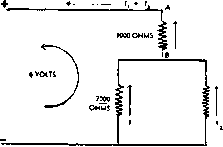 3000 OHMS Figure 3. In this simple network the current divides through the 2000-ohm and 3000-ohm resistors. The current through each may be found by using two simultaneous linear equations. Note that the arrows indicate the direction of electron flow as explained on page 18. An apphcation of two simuhaneous linear equations will now be given. In Figure 3 a simple network is shown consisting of three resistances; let it be required to find the currents Il and Is in the two branches. The general way in which all such problems can be solved is to assign directions to the currents through the various resistances. When these are chosen wrong it will do no harm for the result of the equations will then be negative, showing up the error. In this simple illustration there is, of course, no such difficulty. Next we write the equations for the meshes, in accordance with Kirchhoffs second law. All voltage drops in the direction of the curved arrow are considered positive, the reverse ones negative. Since there are two unknowns we write two equations. 1000 (I, -I- I,) + 2000 I, = б -2000 il -f 3000 I2 = 0 Expand the first equation 3000 ll + 1000 I, = б 1000 OHMS 10 VOLTS 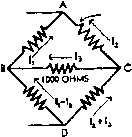 2000 OHMS 3000 OHMS (ООО OHMS Figure 4. A MORE COMPLICATED PROBLEM REQUIRING THE SOLUTION OF CURRENTS IN A NETWORK. This problem Is similar to that In figure 3 but requires the use of three simultaneous linear equations. Multiply this equation by 3 9000 ll + 3000 I, = 18 Subtracting the second equation from the first 11000 и = 18 I, = 18/11000 = 0.00164 amp. Filling in this value in the second equation 3000 и = 3.28 h = 0.00109 amp. A similar problem but requiring three equations is shown in Figure 4. This consists of an unbalanced bridge and the problem is to find the current in the bridge-branch, 1з. We again assign directions to the different currents, guessing at the one marked h. The voltages around closed loops ABC [eq. (1)} and BDC [eq. (2)1 equal zero and are assumed to be positive in a counterclockwise direction; that from D to A equals 10 volts [eq. (3)}. (1) -1000 Ix + 2000 h - 1000 la = 0 - 1000 (ll-la) -f-1 ООО l2-f 3000 (1,+ 1з) =0 (3) 1000 ll -f 1000 (ll - 1з) -10 = 0 Expand equations (2) and (3) (2) -1000 I, -b 3000 h 4- 5000 Ь = 0 2000 ll - 1000 1 - 10 = 0 Subtract equation (2) from equation (1) (a) - 1 ООО 1= - 6000 la = 0 Multiply the second equation by 2 and add it to the third equation 6000 1. + 9000 h - 10 = 0 Now we have but two equations with two unknowns. Multiplying equation (a) by 6 and adding to equation (b) we have - 27000 1з - 10 = 0 I, = -10/27000 = -0.00037 amp. Note that now the solution is negative which means that we have drawn the arrow for I;, in Figure 4 in the wrong direction. The current is 0.37 ma. in the other direction. Second Degree or A somewhat similar Quadratic Equations problem in radio would be, if power in watts and resistance in ohms of a circuit are given, to find the voltage and the current. Example; When lighted to normal brilliancy, a 100 watt lamp has a resistance of 49 ohms; for what line voltage was the lamp designed and what current would it take. Here we have to use the simultaneous equations: P = El and E - IR Filling in the known values: P = El = too and E = IR = I X 49 Substitute the second equation into the first equation P = El = (I) X X 49 = 49 P = 100 amp. Substituting the found value of 1.43 amp. for / in the first equation, we obtain the value of the line voltage, 70 volts. Note that this is a second degree equation for we finally had the second power of I. Also, since the current in this problem could only be positive, the negative square root of 100/49 or -10/7 was not used. Strictly speaking, however, there are two more values that satisfy both equations, these are -1.43 and -70. in general, a second degree equation in one unknown has two roots, a third degree equation three roots, etc. The Quadratic Equation general form Quadratic or second degree equations with but one unknown can be reduced to the ax= + bx + e = 0 where x is the unknown and a, b, and с are constants. This type of equation can sometimes be solved by the method of factoring a three-term expression as follows: factoring: 2x + 7x + б = 0 2x -Ь 4x + 3x + б = 0 2x (X + 2) + 3 (x + 2) = 0 (2x 4-3) (x -I- 2) = 0 There are two possibilities when a product is 2ero. Either the one or the other factor equals zero. Therefore there are two solutions. 2x, -I- 3 = 0 2x, = -3 X. = -\Уг X, + 2 = 0 X, = -2 Since factoring is not always easy, the following general solution can usually be employed; in this equation a, b, and с are the coefficients referred to above. - Ь ± лА b - 4ac 2a Applying this method of solution to the previous example: Y - ~-7±V49 - 8 X 6 -7=-уП -7±1 л--- - -7 - 1 X, = =: -2 A practical example involving quadratics is the law of impedance in a.c. circuits. However, this is a simple kind of quadratic equation which can be solved readily without the use of the special formula given above. Z = VR + <Xb - Xo)* This equation can always be solved for R, by squaring both sides of the equation. It should now be understood that squaring both sides of an equation as well as multiplying both sides with a term containing the unknown may add a new root. Since we know here that Z and R are positive, when we square the expression there is no ambiguity. 2 = R= -I- (Xb - Xo) QndR* = r - (Xb - Xo) orR= V r - (Xl - Хо) Also: (Xl - Хо) =: r - R and ± (Xb - Xo) = V r - R But here we do not know the sign of the solution unless there are other facts which indicate it. To find either Xl or Xc alone it would have to be known whether the one or the other is the larger. Logarithms Definition A logarithm is the power (or ex-ond Use ponent) to which we must raise one number to obtain another. Although the large numbers used in logarithmic work may make them seem difficult or comphcated, in reality the principal use of logarithms is to simplify calculations which would otherwise be extremely laborious. We have seen so far that every operation in arithmetic can be reversed. If we have the addition: a + b = с we can reverse this operation in two ways. It may be that b is the unknown, and then we reverse the equation so that it becomes с - a = b It is also possible that we wish to know a, and that b and с are given. The equation then becomes - b = a We call both of these reversed operations subtraction, and we make no distinction between the two possible reverses. Multiplication can also be reversed in two manners. In the multiplication ab = с we may wish to know a, when b and с are given, or we may wish to know b when a and с are given. In both cases we speak of division, and we make again no distinction between the two. In the case of powers we can also reverse the operation in two manners, but now they are not equivalent. Suppose we have the equation a = c If a is the unknown, and b and с are given, we may reverse the operation by writing V~c = a This operation we call taking the root. But there is a third possibility: that a and с are given, and that we wish to know b. In other HAN DBOOK Logarithms 757 words, the question is to which power must we raise a so as to obtain cT. This operation is known as taking the logarithm, and b is the logarithm of с to the base a. We write this operation as follows: log. с =: b Consider a numerical example. Wc know 2=8. We can reverse this operation by asking to which power must we raise 2 so as to obtain Therefore, the logarithm of 8 to the base 2 is 3, or log, 8 = 3 Taking any single base, such as 2, we might write a series of all the powers of the base next to the series of their logarithms: Number: 2 4 8 16 32 64 128 256 512 1024 Logarithm: 123456 7 8 9 10 We can expand this table by finding terms between the terms listed above. For instance, if we let the logarithms increase with 1/2 each time, successive terms in the upper series would have to be multiplied by the square root of 2. Similarly, if we wish to increase the logarithm by 1/10 at each term, the ratio between two consecutive terms in the upper series would be the tenth root of 2. Now this short list of numbers constitutes a small logarithm table. It should be clear that one could find the logarithm of any number to the base 2. This logarithm will usually be a number with many decimals. Logortthmic The fact that we chose 2 as Bases a base for the illustration Is purely arbitrary. Any base could be used, and therefore there are many possible systems of logarithms. In practice we use only two bases: The most frequently used base is 10, and the system using this base is known as the system of common logarithms, or Briggs logarithms. The second system employs as a base an odd number, designated by the letter e; e = 2.71828. . . . This is known as the natural logarithmic system, also as the Napierian system, and the hyperbolic system. Although different writers may vary on the subject, the usual notation is simply log a for the common logarithm of a, and log a (or sometimes In a) for the natural logarithm of a. We shall use the common logarithmic system in most cases, and therefore we shall examine this system more closely. Common In the system wherein 20 is the Logarithms base, the logarithm of IQ equals J; the logarithm of 100 equals 2, etc.. as shown in the following table:
This table can be extended for numbers less than 10 when we remember the rules of powers discussed under the subject of algebra. Numbers less than unity, too, can be written as powers of ten.
From these examples follow several rules: The logarithm of any number between zero and + 1 is negative; the logarithm of zero is minus infinity; the logarithm of a number greater than + 1 is positive. Negative numbers have no logarithm. These rules are true of common logarithms and of logarithms to any base. The logarithm of a number between the powers of ten is an irrational number, that is, it has a never ending series of decimals. For instance, the logarithm of 20 must be between 1 and 2 because 20 is between 10 and 100; the value of tbe logarithm of 20 is 1.30103. . . . The part of the logarithm to the left of the decimal point is called the characteristic, while the decimals are called the mantissa. In the case of 1.30103 . ., the logarithm of 20, the characteristic is 1 and the mantissa is .30103 . . Properties of Logarithms If the base of our system is ten, then, by definition of a logarithm: 10 = о or, if the base is raised to the power having an exponent equal to the logarithm of a number, the result is that number. The logarithm of a product is equal to the sum of the logarithms of the two factors. log ab = log a + log b This is easily proved to be true because, it Figure 5. FOUR PLACE LOGARITHM TABLES.
was shown before that when multiplying to powers, the exponents are added; therefore, Д [, o X 10 = 10 ° Similarly, the logarithm of a quotient is the difference between the logarithm of the dividend and the logarithm of the divisor. log- - log 0 - log b This is so because by the same rules of exponents: Q( log a - log b) We have thus established an easier way of multiplication and division since these operations have been reduced to adding and subtracting. The logarithm of a power of a number is equal to the logarithm of that number, multiplied by the exponent of the power. log 0 - 2 log о and log a = 3 log a or, in general: log a = n log a Also, the logarithm of a root of a number js equal to the logarithm of that number divided by the index of the root: log v о =-log о It follows from the rules of multiplication, that numbers having the same digits but dif-
log 829 = log (8.29 X ЮО) = log 8.29 + log 100 = 0.918555 -i- 2 Logarithm tables give the mantissas of logarithms only. The characteristic has to be determined by inspection. The characteristic is equal to the number of digits to the left of the decimal point minus one. In the case of logarithms of numbers less than unity, the characteristic is negative and is equal to the number of ciphers to the right of the decimal point plus one. For reasons of convenience in making up logarithm tables, it has become the rule that the mantissa should always be positive. Such notations above as -1.918555 really mean ( + 0.918555 -1) and -2.981555 means (+ 0.918555 - 2). There are also some other notations in use such as T.9I8555 and 2.918555 olso 9.918555 - 10 8.918555 - 10 7.918555 - 10, etc. When, after some addition and subtraction of logarithms a mantissa should come out negative, one cannot look up its equivalent number or anti-logarithm in the table. Tbe mantissa must first be made positive by adding and subtracting an appropriate integral number. Example: Suppose we find that the logarithm of a number is -0.34569, then we can transform it into the proper form by adding and subtracting 1 1 - I -0.34569 0.65431 -1 or -1.65431 Using Logarithm Tables Logarithms are used for calculations involving multiplication, division, powers, and roots. Especially when the numbers are large and for higher, or fractional powers and roots, this becomes the most convenient way. Logarithm tables are available giving the logarithms to three places, some to four places, others to five and six places. The table to use depends on the accuracy required in the result of our calculations. The four place table, printed in this chapter, permits the finding of answers to problems to four significant figures which is good enough for most constructional purposes. If greater accuracy is required a five place table should be consulted. The five place table is perhaps the most popular of all. Referring now to the four place table, to find a common logarithm of a number, proceed as follows. Suppose the number is 5576. First, determine the characteristic. An inspection will show that the characteristic should be 3. This figure is placed to the left of the decimal point. The mantissa is now found by reference to the logarithm table. The first two numbers are 55; glance down the N column until coming to these figures. Advance to the right until coming in line with the column headed 7; the mantissa will be 7459. (Note that the column headed 7 corresponds to the third figure in the number 5576.) Place the mantissa 7459 to the right of the decimal point, making the logarithm of 5576 now read 3.7459. Important: do not consider the last figure 6 in the NL. 0*123454789 P.P. 250 34 7f4 eil 829 846 863 88t 88 fIS f33 fSO Kt 947 985 *002 0I9 ♦037 *054 071 *098*184*123 18 252 40 t40 157 175 l 209 224 243 2*1 278 295 I 1.8 253 312 329 344 344 381 398 415 432 449 444 2 3.6 254 483 500 518 535 552 549 584 403 420 437 3 5.4 4 72 255 454 471 488 705 722 739 754 773 790 807 ate. Figure 6. A SMALL SECTION OF A FIVE PLACE LOGARITHM TABLE. Logprithms may be found wiih greater Accuracy with iueh tables, but they are only ot use when the accuracy ot the original data warrants greater precision in the figure work. Slightly greater accuracy may be obtairted tor intermediate points by interpolation, as explained in (he text. number 5576 when looking for the mantissa in the accompanying four place tables; in fact, one may usually disregard all digits beyond the first three when determining the mantissa. (Inlerpolation. sometimes used to find a logarithm more accurately, is unnecessary unless warranted by unusual accuracy in the available data.) However, be doubly sure to include all figures when ascertaining the magnitude of the characteristic. To find the anti-logarithm, the table is used in reverse. As an example, let us find the anti-logarithm of 1.272 or, in other words, find the number of which 1.272 is the logarithm. Look in the table for the mantissa closest to 272. This is found in the first half of the table and the nearest value is 2718. Write down the first two significant figures of the anti-logarithm by taking the figures at the beginning of the line on which 2718 was found. This is 18; add to this, the digit above the column in which 2718 was found; this is 7. The anti-logarithm is 187 but we have not yet placed the decimal point. The characteristic is 1, which means that there should be two digits to the left of the decimal point. Hence, 18.7 is the anti-logarithm of 1.272. For the sake of completeness we shall also describe the same operation with a five-place table where interpolation is done by means of tables of proportional parts (P.P. tables). Therefore we are reproducing here a small part of one page of a five-place table. Finding the logarithm of 0.025013 is done as follows: We can begin with the characteristic, which is -2. Next find the first three digits in the column, headed by N and immediately after this we see 39, the first two digits of the mantissa. Then look among the headings of the other columns for the next digit of the number, in this case 1. In the column, headed by 1 and on the line headed 2.50, we find the next three digits of the logarithm, 811. So far. the logarithm is -2.39811 but this is the logarithm of 0.025010 and we want the logarithm of 0.025013. Here we can interpolate by observing that the difference between the log of 0.02501 and 0.02502 is 829 - 811 or 18, in the last two significant figures. Looking in the P.P. table marked 18 we find after 3 the number 5.4 which is to be added to the logarithm. -2.39811 -2.39816, the logarithm of 0.025013 Since our table is only good to five places, we must eliminate the last figure given in the P.P. table if it is less than 5, otherwise we must add one to the next to the last figure, rounding off to a whole number in the P.P. table. Finding the anti-logarithm is done the same way but with the procedure reversed. Suppose it is required to find the anti-logarithm of 0.40100. Find the first two digits in the column headed by L. Then one must look for the next three digits or the ones nearest to it, in the columns after 40 and on the lines from 40 to 41. Now here we find that numbers in the neighborhood of 100 occur only with an asterisk on the line just before 40 and still after 39. The asterisk means that instead of the 39 as the first two digits, these mantissas should have 40 as the first two digits. The logarithm 0.40100 is between the logs 0.40088 and 0.40106; the anti-logarithm is between 2517 and 2518. The difference between the two logarithms in the table is again 18 in the last two figures and our logarithm 0.40100 differs with the lower one 12 in the last figures. Look in the P.P. table of 18 which number comes closest to 12. This is found to be 12.6 for 7 X 1.8 = 12.6. Therefore we may add the digit 7 to the antl-Iogarithm already found; so we have 25177. Next, place the decimal point according to the rules: There are as many digits to the left of the decimal point as indicated in the characteristic plus one. The anti-logarithm of 0.40100 is 2.5177. In the following examples of the use of logarithms we shall use only three places from the tables printed in this chapter since a greater degree of precision in our calculations would not be warranted by the accuracy of the data given. In a 375 ohm bias resistor flows a current of 41.5 milliamperes; how many watts are dissipated by the resistor. We write the equation for power in watts: P= PR 1 ... 73 74 75 76 77 78 79 80 |
||||||||||||||||||||||||||||||||||||||||||||||||||||||||||||||||||||||||||||||||||||||||||||||||||||||||||||||||||||||||||||||||||||||||||||||||||||||||||||||||||||||||||||||||||||||||||||||||||||||||||||||||||||||||||||||||||||||||||||||||||||||||||||||||||||||||||||||||||||||||||||||||||||||||||||||||||||||||||||||||||||||||||||||||||||||||||||||||||||||||||||||||||||||||||||||||||||||||||||||||||||||||||||||||||||||||||||||||||||||||||||||||||||||||||||||||||||||||||||||||||||||||||||||||||||||||||||||||||||||||||||||||||||||||||||||||||||||||||||||||||||||||||||||||||||||||||||||||||||||||||||||||||||||||||||||||||||||||||||||||||||||||||||||||||||||||||||||||||||||||||||||||||||||||||||||||||||||||||||||||||||||||||||||||||||||||||||||||||||||||||||||||||||||||||||||||||||||||||||||||||||||||||||||||||||||||||||||||||||||||||||||||||||||||||||||||||||||||||||||||||||||||||||||||||||||||||||||||||||||||||||||||||||||||||||||||||||||||||||||||||||||||||||||||||||||||||||||||||||||
|
© 2026 AutoElektrix.ru
Частичное копирование материалов разрешено при условии активной ссылки |