 |
 |
 |
| Главная Журналы Популярное Audi - почему их так назвали? Как появилась марка Bmw? Откуда появился Lexus? Достижения и устремления Mercedes-Benz Первые модели Chevrolet Электромобиль Nissan Leaf |
Главная » Журналы » Metal oxide semiconductor 1 ... 47 48 49 50 51 52 53 ... 91 FIGURE 20.15 The 78XX series fixed positive voltage regulator. must be at least 2 V above the output voltage. Table 20.1 shows the minimum and maximum input voltages of the 78XX series fixed positive vohage regulator. The 79XX series voltage regulator is identical to the 78XX series except that it provides negative regulated voltages instead of positive ones. Figure 20.16 shows the standard configuration of a 79XX series voltage regulator. A list of 79XX series regulators is provided in Table 20.2. The regulation of the circuit can be maintained as long as the output voltage is at least 2 to 3 V greater than the input voltage. 20.4.2 Adjustable Positive and Negative Linear Voltage Regulators 1С voltage regulators are also available in circuit configurations that allow the user to set the output voltage to a desired TABLE 20.1 regulators Minimum and maximum input voltages for 78XX series
TABLE 20.2 Minimum and maximum input voltages for 79XX series regulators
regulated value. The LM317 adjustable positive voltage regulator, for example, is capable of supplying an output current of more than 1.5 A over an output voltage range of 1.2 to 37 V. Figure 20.17 shows how the output voltage of an LM317 can be adjusted by using two external resistors and R2. The capacitors Q and c2 have the same function as those in the fixed linear voltage regulator. As indicated in Fig. 20.17, the LM317 has a constant 1.25 V reference voltage, Vpp, across the output and the adjustment terminals. This constant reference voltage produces a constant current through R regardless of the value of R2. The output voltage is given by V=V, (20.13) where Ij is a constant current into the adjustment terminal and has a value of approximately 50 pA for the LM317. As can be seen from (20.13), with fixed Ri, can be adjusted by varying R2. The LM337 adjustable voltage regulator is similar to the LM317 except that it provides negative regulated voltages instead of positive ones. Figure 20.18 shows the standard configuration of a LM337 voltage regulator. The output voltage can be adjusted from -1.2 to -37 V, depending on the external resistors Ri and R2. FIGURE 20.16 The 79XX series fixed negative voltage regulator. FIGURE 20.17 The LM317 adjustable positive voltage regulator. where i is the maximum current that the vohage regulator can handle internally. 20.5 Switching Regulators FIGURE 20.18 The LM337 adjustable negative voltage regulator. 20.4.3 Applications of Linear 1С Voltage Regulators Most 1С regulators are limited to an output current of 2.5 A. If the output current of an 1С regulator exceeds its maximum aUowable limit, its internal pass transistor wiU dissipate an amount of energy more than it can tolerate. As a result, the regulator wiU be shut down. For applications that require more than the maximum aUowable current limit of a regulator, an external pass transistor can be used to increase the output current. Figure 20.19 iUustrates such a configuration. This circuit has the capabUity of producing higher current to the load, but stiU preserving the thermal shutdown and short-circuit protection of the 1С regulator. A constant current-hmiting scheme, as discussed in Section 20.2.2, is implemented by using the transistor Q2 and the resistor R2 to protect the external pass transistor from excessive current under current-overload or short-circuit conditions. The value of the external current-sensing resistor Rl determines the value of current at which begins to conduct. As long as the current is less than the value set by Rp the transistor is off, and the regulator operates normally as shown in Fig. 20.15. But when the load current 4 starts to increase, the voltage across Ri also increases. This turns on the external transistor and conducts the excess current. The value of Rl is determined by Ri = 0.7V (20.14) The linear series and shunt regulators have control transistors that are operating in their hnear active regions. Regulation is achieved by varying the conduction of the transistors to maintain the output voltage at a desirable level. The switching regulator is different in that the control transistor operates as a switch, either in the cutoff or the saturation region. Regulation is achieved by adjusting the on time of the control transistor. In this mode of operation, the control transistor does not dissipate as much power as that in the linear types. Therefore, switching voltage regulators have a much higher efficiency and can provide greater load currents at low voltage than linear regulators. Unlike their linear counterparts, switching regulators can be implemented by many different topologies such as forward and flyback. In order to select an appropriate topology for an application, it is necessary to understand the merits and drawbacks of each topology and the requirements of the application. Basically, most topologies can work for various applications. Therefore, we have to determine from the factors such as cost, performances, and apphcation that make one topology more desirable than the others. However, no matter which topology we decide to use, the basic buUding blocks of an off-the-line switching power supply are the same, as depicted in Fig. 20.1. In this section, some popular switching regulator topologies, namely flyback, forward, half-bridge, and fuU-bridge topologies, are presented. Their basic operation is described, and the critical waveforms are shown and explained. The merits, drawbacks, and apphcation areas of each topology are discussed. Finally, the control circuitry and pulse-width modulation (PWM) of the regulators are also discussed. 20.5.1 Single-Ended Isolated Flyback Regulators An isolated flyback regulator consists of four main circuit elements: a power switch, a rectifier diode, a transformer, and a filter capacitor. The power switch, which can be either a power transistor or a MOSFET, is used to control the flow of energy in the circuit. A transformer is placed between the input source and the power switch to provide DC isolation between the input and the output circuits. In addition to being an energy storage element, the transformer also performs a stepping up or down function for the regulator. The rectifier diode and filter capacitor form an energy transfer mechanism to supply energy to maintain the load voltage and current of the supply. Note that there are two distinct operating modes for flyback regulators: continuous and discontinuous. However, both modes have an identical circuit. It is only the transformer magnetizing current that determines the operating mode of the regulator. Figure 20.20a shows a simphfied isolated flyback regulator. The associated steady-state waveforms, resulting from discontinuous-mode operation, is shown in Fig. 20.20b. As shown in the figure, the voltage regulation of the regulator is achieved by a control circuit, which controls the conduction period or duty cycle of the switch, to keep the output voltage at a constant level. For clarity, the schematics and operation of the control circuit wiU be discussed in a separate section. 20.5.1.1 Discontinuous-Mode Flyback Regulators Under steady-state conditions, the operation of the regulator can be explained as foUows. When the power switch is on, the primary current Ip starts to buUd up and stores energy in the primary winding. Because of the opposite-polarity arrangement between the input and output windings of the transformer, the rectifier diode CR is reverse biased. In this period of time, there is no energy transferred from the input to the load Rp. The output voltage is supported by the load current I I, which is supplied from the output filter capacitor C. When Ql is turned off, the polarity of the windings reverses as a result of the fact that Ip cannot change instantaneously. This causes CR to turn on. Now CR is conducting, charging the output capacitor С and delivering current to Rp. This charging action ends at the point where aU the magnetic energy stored in the secondary winding during the first half-cycle is emptied. At this point, CR wiU cease to conduct and Rp absorbs energy just from С untU Qi is switched on again. During the Qi on time, the voltage across the primary winding of the transformer is V. The current in the primary winding Ip increases linearly and is given by (20.15) where Lp is the primary magnetizing inductance. At the end of the on time, the primary current reaches a value equal to Ip(p and is given by (20.16) О where D is the duty cycle and T is the switching period. Now when Ql turns off, the magnetizing current in the transformer forces the reversal of polarities on the windings. At the instant of turn-off, the amplitude of the secondary current Ipj is Pipk) (20.17) This current decreases linearly at a rate of (20.18) where L is the secondary magnetizing inductance. In the discontinuous-mode operation, Ip wiU decrease linearly to zero before the start of the next cycle. Since the energy transfer from the source to the output takes place only in the first half-cycle, the power drawn from is then 2 Vp (20.19) FIGURE 20.20 A simplified isolated flyback regulator: (a) circuit, (b) associated waveforms. Substituting (20.15) into (20.19), we have 2TL, The output power may be written as Po = ПРгп 2TL, (20.21) where rj is the efficiency of the regulator. Then, from (20.21), the output voltage is related to the input voltage by К = VD (20.22) Since the collector voltage Vq of is maximum when is maximum, the maximum collector voltage Vqmax) shown in Fig. 20.20b, is given by Ql(max) ~ i(max) (20.23) The primary peak current Jj.) can be found in terms of by combining (20.16) and (20.21) and then eUminating Lp as lV,D (20.24) The maximum collector current Ic(max) of the power switch at turn-on is C(max) - pipk) (20.25) As can be seen from (20.21), wiU maintain constant by keeping the product Vjt constant. Since maximum on time on(max) occurs at minimum supply vohage Vy the maximum aUowable duty cycle for the discontinuous mode can be found from (20.22) as 20.5.1.2 Continuous-Mode Flyback Regulators In the continuous-mode operation, the power switch is turned on before aU the magnetic energy stored in the secondary winding empties itself. The primary and secondary current waveforms have a characteristic appearance as shown in Fig. 20.21. This mode produces a higher power capability without increasing Ip. During the on time, the primary current Ip rises linearly from its initial value /(0) and is given by (20.28) At the end of the on time, the primary current reaches a value equal to Ipil and is given by Y:DT (20.29) In general, UO) > У^ВТ/Е', thus, (20.29) can be written as p{pk) (20.30) The secondary current I(p at the instant of turn-off is given by 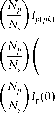 4(0) + V:DT\ This current decreases linearly at a rate of dt L, (20.31) (20.32) The output power P is equal to times the time average of the secondary current pulses and is given by P -V I T-t . (20.33) V 2I (20.26) and V at is then V = V; * 0 * /(min)-max. MRlT (20.27) FIGURE 20.21 The primary and secondary winding currents of a flyback regulator operated in the continuous mode. For an efficiency of rj, the input power is (20.34) At the transition from the discontinuous mode to continuous mode, the relationships in (20.27) and (20.38) must hold. Thus, equating these two equations, we have i(min)-max. Npl-D ax i(min) (20.42) P = Solving this equation for Lp, we have - VI - (20.35) (20.36) Combining (20.31), (20.34), and (20.36) and solving for Vq. we have The output voltage at D is then (20.37) (20.38) The maximum collector current /c(max) the continuous mode is then given by C(max) - p(pk) (20.39) The maximum coUector voltage of is the same as that in the discontinuous mode and is given by Ql(max) = V,.( ) + ()y (20.40) The maximum allowable duty cycle for the continuous mode can be found from (20.38) and is given by (20.41) ip(limit) - i Pol (1-0ах)тГ (1 - D ) (20.43) Replacing У„ with (20.38) and solving for /p/iin,it)> we have 1 Di,.Vl max i(min) (20.44) Then, for a given D, input, and output quantities, the inductance value I p(limit) in (20.44) determines the mode of operation for the regulator. If Lp < ip(iiniit)5 then the circuit is operated in the discontinuous mode. Otherwise, if Lp > /p(iiniit)5 the circuit is operated in the continuous mode. In designing flyback regulators, regardless of their operating modes, the power switch must be able to handle the peak coUector voltage at turn-off and the peak collector currents at turn-on as shown in (20.23), (20.25), (20.39), and (20.40). The flyback transformer, because of its unidirectional use of the B-H curve, has to be designed so that it wiU not be driven into saturation. To avoid saturation, the transformer needs a relatively large core with an air gap in it. Although the continuous and discontinuous modes have an identical circuit, their operating properties differ significantly. As opposed to the discontinuous mode, the continuous mode can provide higher power capabUity without increasing the peak current Ip. It means that, for the same output power, the peak currents in the discontinuous mode are much higher than those operated in the continuous mode. As a result, a higher current rating and, therefore, a more expensive power transistor is needed. Moreover, the higher secondary peak currents in the discontinuous mode wiU have a larger transient spike at the instant of turn-off. FLowever, despite aU these problems, the discontinuous mode is stiU much more widely used than its continuous-mode counterpart. There are two main reasons. First, as mentioned earlier, the inherently smaUer magnetizing inductance gives the discontinuous mode a quicker response and a lower transient output voltage spike to sudden changes in load current or input voltage. Second, the continuous mode has a right-half-plane zero in its transfer function, which makes the feedback control circuit more difficult to design. The flyback configuration is mostly used in applications with output power below 100 W. It is widely used for high output voltages at relatively low power. The essential attractions of this configuration are its simphcity and low cost. Since no output filter inductor is required for the secondary, there is a significant saving in cost and space, especially for multiple output power supplies. Since there is no output filter inductor, the flyback exhibits high ripple currents in the transformer and at the output. Thus, for higher power applications, the flyback becomes an unsuitable choice. In practice, a smaU L С filter is added after the filter capacitor С in order to suppress high-frequency switching noise spikes. As mentioned previously, the collector voltage of the power transistor must be able to sustain a voltage as defined in (20.23). In cases where the voltage is too high for the transistor to handle, the double-ended flyback regulator shown in Fig. 20.22 may be used. The regulator uses two transistors that are switched on or off simultaneously. The diodes CRi and CR2 are used to restrict the maximum coUector voltage to V. Therefore, the transistors with a lower voltage rating can be used in the circuit. 20.5.2 Single-Ended Isolated Forward Regulators Although the general appearance of an isolated forward regulator resembles that of its flyback counterpart, their operations are different. The key difference is that the dot on the secondary winding of the transformer is so arranged that the output diode is forward-biased when the voltage across the primary is positive, that is, when the transistor is on. Energy is thus not stored in the primary inductance as it was for the flyback. The transformer acts strictly as a transformer. An inductive energy storage element is required at the output for proper and efficiency energy transfer. Unlike the flyback, the forward regulator is very suitable for working in the continuous mode. In the discontinuous mode, the forward regulator is more difficult to control because of a double pole at the output filter. Thus, it is not as much used as the continuous mode. In view of this, only the continuous mode wiU be discussed here. Figure 20.23 shows a simplified isolated forward regulator and the associated steady-state waveforms for continuous-mode operation. Again, for clarity, the detaUs of the control circuit are omitted from the figure. Under steady-state condition, the operation of the regulator can be explained as follows. When the power switch turns on, the primary current Ip starts to buUd up and stores energy in the primary winding. Because of the same-polarity arrangement of the primary and secondary windings, this energy is forward-transferred to the secondary and onto the L С filter and the load Rl through the rectifier diode Ci2 which is forward biased. When turns off, the polarity of the transformer winding voltage reverses. This causes CR2 to turn off and CR and Ci3 to turn on. Now CR is conducting and delivering energy to Ri through the inductor L. During this period, the diode CRi and the tertiary winding provide a path for the magnetizing current returning to the input. When the transistor is turned on, the voltage across the primary winding is V. The secondary winding current is reflected into the primary, and the reaction current Ip, as shown in Fig. 20.24, is given by (20.45) The magnetizing current in the primary has a magnitude of Lag and is given by mag - The total primary current Ip is then (20.46) T = I -\- I p mag (20.47) The voltage developed across the secondary winding is (20.48) Neglecting diode voltage drops and losses, the voltage across the output inductor is - V. The current in L increases linearly at a rate of 4l = (20.49) At the end of the on-time, the total primary current reaches a peak value equal to 1 and is given by V:DT (20.50) The output inductor current is kupk) - 41(0) H---- (20.51) At the instant of turn-on, the amplitude of the secondary current has a value of Ipj and is given by О V,DT (20.52) FIGURE 20.23 A simplified isolated forward regulator: (a) circuit, (b) associated waveforms. During the off-time, the current in the output inductor is equal to the current Ir in the rectifier diode Ci3 and both decrease linearly at a rate of (20.53) The output voltage can be found from the time integral of the secondary winding voltage over a time equal to DT of the switch Qj. Thus, we have 0 rj (20.54) The maximum collector current /c(max) turn-on is equal to Pipk) nd is given by C(max) - pipk) V DT (20.55) The maximum collector voltage Vqj at turn-off is equal to the maximum input voltage V plus the maximum voltage f(max) across the tertiary winding and is given by Ql(max) = i(max) + f(max) (20.56) FIGURE 20.24 The current components in the primary winding. The maximum duty cycle for the forward regulator operated in the continuous mode can be determined by equating the time integral of the input voltage when is on and the clamping voltage when is off, V:dt = which leads to y.DT = VXl - D)T (20.57) (20.58) Grouping the D terms in (20.58) and replacing V/V- with N/Np, we have (20.59) Thus, the maximum duty cycle depends on the turn ratio between the demagnetizing winding and the primary one. In designing forward regulators, the duty cycle must be kept below the maximum duty cycle D to avoid saturating the transformer. It should also be noted that the transformer magnetizing current must be reset to zero at the end of each cycle. Failure to do so wiU drive the transformer into saturation, which can cause damage to the transistor. There are many ways of implementing the resetting function. In the circuit shown in Figure 20.23(a), a tertiary winding is added to the transformer so that the magnetizing current wiU return to the input source when the transistor turns off. The primary current always starts at the same value under steady-state conditions. Unlike flyback regulators, forward regulators require a minimum load at the output. Otherwise, excess output voltage will be produced. One method commonly used to avoid this situation is to attach a small load resistance at the output terminals. Of course, with such an arrangement, a certain amount of power wiU be lost in the resistor. Because forward regulators do not store energy in their transformers, for the same output power level the transformer can be made smaUer than for the flyback type. The output current is reasonably constant owing to the action of the output inductor and the flywheel diode; as a result, the output filter capacitor can be made smaller and its ripple current rating can be much lower than that required for the flybacks. The forward regulator is widely used with output power below 200 W, though it can be easily constructed with a much higher output power. The limitation comes from the capabUity of the power transistor to handle the voltage and current stresses if the output power were to increase. In this case, a configuration with more than one transistor can be used to share the burden. Figure 20.25 shows a double-ended forward regulator. Like the double-ended flyback counterpart, the circuit uses two transistors that are switched on and off simultaneously. The diodes are used to restrict the maximum coUector voltage to V. Therefore, transistors with low voltage ratings can be used in the circuit. 20.5.3 Half-Bridge Regulators The half-bridge regulator is another form of an isolated forward regulator. When the voltage on the power transistor in the single-ended forward regulator becomes too high, the half-bridge regulator is used to reduce the stress on the transistor. In a half-bridge regulator, the voltage stress imposed on the power transistors is subject to only the input voltage and is only half of that in a forward regulator. Thus, the output power of a half-bridge is double that of a forward regulator for the same semiconductor devices and magnetic core. Figure 20.26 shows the basic configuration of a half-bridge regulator and the associated steady-state waveforms. As seen in Fig. 20.26a, the half-bridge regulator can be viewed as two back-to-back forward regulators, fed by the same input voltage, each delivering power to the load at each alternate half cycle. The capacitors and C2 are placed between the input and ground terminals. As such, the voltage across the primary winding is always half the input voltage. The power switches and Q2 are switched on and off alternately to produce a square-wave ac at the input of the transformer. This square-wave is stepped either down or up by the isolation transformer and then rectified by the diodes CRi and CR2. Subsequently, the rectified voltage is filtered to produce the output voltage V. Under steady-state conditions, the operation of the regulator can be explained as foUows. When is on and Q2 off, CRi conducts and CR2 is reverse-biased. The primary voltage Vp is Vj/2. The primary current Ip starts to buUd up and stores energy in the primary winding. This energy is forward-transferred to the secondary and onto the С filter and the load Rl, through the rectifier diode CR. During the time interval A, when both and Q2 are off, CRi and CR2 are forced to conduct to carry the magnetizing current that resulted in the interval during which is turned on. The inductor current I in this interval is equal to the sum of the currents in CRi and CR2. This interval terminates at half of the switching period T, when Q2 is turned on. When Q2 is on and Ql off, CRi is reverse-biased and CR2 conducts. The primary voltage Vp is now -Vll. The circuit operates in a similar manner as during the first half-cycle. With Ql on, the voltage across the secondary winding is О (20.60) Neglecting diode voltage drops and losses, the voltage across the output inductor is then given by /I, (20.61) FIGURE 20.26 A simplified half-bridge regulator: (a) circuit, (b) the associated waveforms. In this interval, the inductor current I increases linearly at a rate of (20.62) At the end of on-time, reaches a value that is given by As mentioned, the maximum coUector voltages for and Q2 at turn-off are given by (20.63) C(max) - i(max) (20.71) During the interval A, is equal to the sum of the rectifier diode currents. Assuming the two secondary windings are identical, is given by hi - hm - CR2 This current decreases linearly at a rate of (20.64) (20.65) The next half-cycle repeats with Q2 on and for the interval A. The output voltage can be found from the time integral of the inductor voltage over a time equal to T. Thus, we have Vo = 2x- DT , T/2+DT T/2 -Vjt (20.66) Note that the multipher of 2 appears in (20.66) because of the two alternate half-cycles. Solving (20.66) for V, we have (20.67) The output power is given by In designing half-bridge regulators, the maximum duty cycle can never be greater than 50%. When both the transistors are switched on simultaneously, the input voltage is short-circuited to ground. The series capacitors Q and c2 provide a dc bias to balance the volt-second integrals of the two switching intervals. Hence, any mismatch in devices would not easily saturate the core. However, if such a situation arises, a smaU coupling capacitor can be inserted in series with the primary winding. A dc bias voltage proportional to the volt-second imbalance is developed across the coupling capacitor. This balances the volt-second integrals of the two switching intervals. One problem in using half-bridge regulators is related to the design of the drivers for the power switches. Specifically, the emitter of is not at ground level, but is at a high ac level. The driver must therefore be referenced to this ac level. Typically, transformer-coupled drivers are used to drive both switches, thus solving the grounding problem and aUowing the controUer to be isolated from the drivers. The half-bridge regulator is widely used for medium-power apphcations. Because of its core-balancing feature, the half-bridge becomes the predominant choice for output power ranging from 200 to 400 W. Since the half-bridge is more complex, for apphcation below 200 W, the flyback or forward regulator is considered to be a better choice and more cost-effective. Above 400 W, the primary and switch currents of the half-bridge become very high. Thus, it becomes unsuitable. Po = у oh (20.68) (20.69) where ipiavg) has the value of the primary current at the center of the rising or faUing ramp. Assuming the reaction current Ip reflected from the secondary is much greater than the magnetizing current, then the maximum coUector currents for and Q2 are given by C(max) - {avg) (20.70) 20.5.4 Full-Bridge Regulators The fuU-bridge regulator is yet another form of isolated forward regulator. Its performance is improved over that of the half-bridge regulator because of the reduced peak coUector current. The two series capacitors that appeared in half-bridge circuits are now replaced by another pair of transistors of the same type. In each switching interval, two of the switches are turned on and off simultaneously such that the fuU input voltage appears at the primary winding. The primary and the switch currents are only half that of the half-bridge for the same power level. Thus, the maximum output power of this topology is twice that of the half-bridge. Figure 20.27 shows the basic configuration of a fuU-bridge regulator and the associated steady-state waveforms. Four power switches are required in the circuit. The power switches Ql and Q4 turn simultaneously on and off in one of the half-cycles. Q2 and Q3 also turn simultaneously on and off in the other half-cycle, but with the opposite phase to and Q4. This produces a square-wave ac with a value of ibV at the primary winding of the transformer. Like the half-bridge, this 1 ... 47 48 49 50 51 52 53 ... 91 |
|
© 2026 AutoElektrix.ru
Частичное копирование материалов разрешено при условии активной ссылки |